

Solid Wood Kitchen Cabinets UK: The Complete Guide to Timber Cabinetry
A thorough guide to solid wood kitchen cabinets in the UK — covering timber species, construction methods, wood movement, finishing options, sustainability, and why genuine hardwood cabinetry is worth the investment for a kitchen built to last generations.
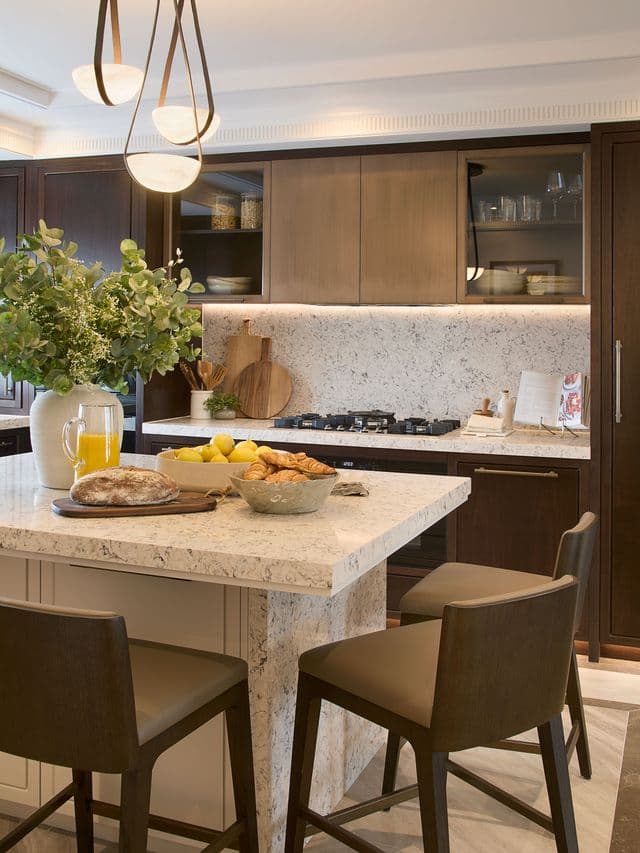
There is a moment, early in any kitchen consultation, when we ask clients to consider what their kitchen will be in twenty years' time. Not what colour they'd like the walls, or which tap has caught their eye on Instagram — but what the cabinets themselves will look, feel, and function like after two decades of daily life.
It's a question that sorts materials rather efficiently. Chipboard, however well laminated, has a finite life. MDF, painted beautifully, will serve admirably for a while but cannot be repaired in quite the same way. Solid wood, though? Solid wood is the one material that actually improves with time. It develops a patina. It can be refinished. It carries the quiet authority of something made from a tree, not from a factory process.
If you're considering solid wood kitchen cabinets for your UK home, this guide covers everything you need to know — from choosing the right timber species to understanding the construction methods that make the difference between cabinetry that lasts a generation and cabinetry that lasts a lifetime.
Why Solid Wood Matters
The case for solid wood kitchen cabinets rests on three pillars: durability, beauty, and repairability. Let's take each in turn.
Durability That Board Products Cannot Match
Solid timber is remarkably strong in relation to its weight. A well-constructed oak carcass will withstand decades of use — drawers opened and closed thousands of times, heavy crockery loaded and unloaded, the occasional slam from a teenager who has been asked to empty the dishwasher. The timber itself does not delaminate, because there are no layers to separate. It does not swell and disintegrate when it encounters moisture, as chipboard will. It simply endures.
This matters enormously in a kitchen, which is arguably the most demanding environment in any home. Heat, steam, water, and constant physical use conspire against lesser materials. Solid wood takes it in its stride.
A Beauty That Deepens With Age
Every piece of timber carries the fingerprint of the tree it came from — its growth rings, its grain figure, its subtle variations in colour and tone. No two boards are identical, and this natural variation gives solid wood kitchens a depth and warmth that no manufactured board can replicate.
More importantly, solid timber ages gracefully. An oiled oak surface develops a richer, deeper tone over the years. A painted tulipwood cabinet acquires the gently worn character that makes a kitchen feel like home. This is the polar opposite of manufactured materials, which tend to look their best on the day they're installed and decline steadily thereafter.
The Ability to Repair, Not Replace
Perhaps the most compelling argument for solid wood kitchen cabinets is what happens when something goes wrong — or simply when tastes change. A scratch in solid timber can be sanded out. A dent can be steamed and filled. An entire surface can be stripped back and refinished in a different colour. Try doing any of that with a foil-wrapped MDF door and you'll see the difference immediately.
This repairability is not a minor detail. It is what transforms a kitchen from a product with a fixed lifespan into a piece of your home that can evolve over decades. It is, in our view, the single strongest reason to choose bespoke cabinetry built from solid timber.
Popular Timber Species for Kitchen Cabinets
Choosing the right timber is one of the most consequential decisions in any kitchen project. Each species brings its own character, working properties, and aesthetic to the finished result.
English Oak
There is something deeply satisfying about using English oak in a kitchen — knowing the timber was grown on these islands, seasoned in a British yard, and shaped by a local maker. English oak tends to have a wilder, more characterful grain than its European cousin, with more variation in colour and figure. It is superb for rustic, country, and heritage schemes where the timber's natural personality is part of the design.
Availability can be limited compared with imported stock, and boards may require more careful selection for consistency. But for clients who value provenance, there is nothing quite like it.
European Oak
European oak is the workhorse of fine cabinetry and the timber we use most frequently at Albury House. It is hard (around 1,120 on the Janka scale), dimensionally stable once properly kiln-dried, and takes virtually any finish you care to put on it — oiled, waxed, lacquered, limed, or painted.
The grain is bold but controlled, with a warmth that suits everything from traditional country kitchens to clean contemporary designs. Quarter-sawn European oak, with its distinctive medullary ray figure and exceptional stability, is particularly prized for door panels and visible surfaces.
American Walnut
For clients who want drama and richness, American black walnut is difficult to surpass. Its deep chocolate-brown heartwood, often streaked with purples and golds, produces some of the most visually arresting cabinetry in the kitchen world. The grain swirls and flows in ways that make every surface a conversation piece.
Walnut is softer than oak (around 1,010 Janka), but more than adequate for cabinet construction. It responds beautifully to a hand-rubbed oil finish, which brings out the full depth and complexity of the grain. We find walnut particularly effective for island units and feature pieces within a larger scheme, where its richness can be appreciated without overwhelming the room.
Tulipwood (American Tulip Poplar)
If your solid wood kitchen cabinets are to be painted — and many of the finest kitchens are — tulipwood is almost certainly the timber your cabinetmaker will recommend. This American hardwood has an exceptionally fine, uniform grain that produces a flawless surface under paint. It machines beautifully, accepts primer without fuss, and is stable enough to resist the seasonal movement that can crack painted finishes on less forgiving species.
Tulipwood is relatively soft (around 540 Janka), which means it's not ideal for exposed, natural-finish surfaces in heavy-use areas. But as a substrate for hand-painted cabinetry, it is peerless. The majority of our painted kitchens at Albury House are built in tulipwood for precisely this reason.
Maple
Hard maple is pale, tight-grained, and one of the hardest timbers commonly used in cabinetry (around 1,450 Janka). It suits contemporary and Scandinavian-influenced schemes where a clean, light aesthetic is desired. The grain is subtle — almost invisible in some boards — allowing the form and proportions of the cabinetry to speak without distraction.
Maple is also an outstanding choice for interior components: drawer boxes, shelf edges, and internal fittings where hardness and wear resistance matter most.
Ash
English ash is a timber with enormous character. Its pronounced, flowing grain and pale straw colour give it a distinctly natural, almost organic quality. It is hard (around 1,320 Janka), strong, and takes staining well for those who want to adjust its naturally light tone.
Ash has become increasingly sought-after in recent years, partly because of its beauty and partly — poignantly — because ash dieback disease has made British-grown ash timber available in greater quantities than the standing tree population might suggest in future decades. Using it now, in a well-made kitchen, is a form of stewardship.
Cherry
American cherry is the quiet romantic of the timber world. Its heartwood starts as a warm pinkish-brown and deepens, over exposure to light, into a rich reddish-amber. This natural colour change is one of cherry's most distinctive features — your kitchen will quite literally grow more beautiful as it ages.
Cherry is moderately hard (around 950 Janka) with a fine, smooth grain that finishes superbly under oil or lacquer. It is not as commonly specified as oak or walnut in the UK, but for clients who appreciate its unique ageing properties, it offers something no other timber can.
Comparing Timber Species at a Glance
When selecting timber for your kitchen, it helps to consider several properties together. Hardness affects durability. Grain character determines how the surface looks and feels. Colour sets the overall mood. Workability influences cost and construction options.
Oak stands at the centre of these considerations — hard enough for any application, characterful enough for natural finishes, and workable enough for complex joinery. Walnut trades some hardness for unmatched visual richness. Tulipwood sacrifices surface hardness for the finest paintable surface available. Maple is the hardest of the group but also the most restrained in character. Ash offers an excellent balance of hardness and visual interest. Cherry is the specialist choice for those who want a timber that changes with time.
There is no objectively superior species. The right timber is the one that serves your design, your lifestyle, and your aesthetic preferences. Many of our bespoke kitchen projects combine two or even three species — painted tulipwood carcasses with oiled oak internals and a walnut island, for instance.
Solid Timber vs Veneered Panels
This is a debate that comes up in almost every kitchen consultation, and it deserves an honest answer.
Veneered panels — a thin slice of real timber bonded to an engineered substrate such as MDF or plywood — offer certain practical advantages. They are dimensionally stable, resistant to warping, and allow the use of figured timbers that might be too unstable or scarce in solid form. A well-applied veneer on a high-quality substrate can look indistinguishable from solid timber.
So why choose solid wood?
First, there is the question of longevity. A veneer is typically 0.6mm to 1mm thick. It can be lightly sanded once, perhaps twice, but it cannot be stripped back and refinished repeatedly in the way that solid timber can. Over a 30-year kitchen life, that limitation becomes significant.
Second, there is the matter of edges. Solid timber has no visible join between face and edge — because they are the same piece of material. Veneered panels require edge lipping, and however carefully this is applied, it remains a potential point of failure and a visible detail under close inspection.
Third, and most subjectively, there is a tactile quality to solid wood that veneer cannot fully replicate. The weight in the hand. The depth when you look at it from an angle. The way it sounds when you tap it. These are not things that appear on a specification sheet, but they are things you live with every day.
At Albury House, we use solid timber for all visible surfaces and reserve engineered boards for concealed structural elements where their stability is genuinely advantageous — cabinet backs and shelf cores, for example. This is not dogma; it's pragmatism guided by decades of experience.
Construction Methods: Frame and Panel
The most important thing to understand about solid wood kitchen cabinets is that timber moves. It expands and contracts with changes in humidity, primarily across the grain. A 300mm-wide oak panel might gain or lose 2-3mm in width between a dry winter and a humid summer. This is entirely normal and cannot be prevented.
The traditional solution — and the correct one — is frame-and-panel construction. A solid timber frame is jointed at the corners (typically with mortise-and-tenon joints), and a thinner panel sits within grooves cut into the frame's inner edges. The panel is free to expand and contract within these grooves without exerting force on the frame.
This method has been used for centuries precisely because it works. The frame provides the structural rigidity. The panel provides the surface area. And the gap between the two — sometimes concealed with a moulding, sometimes left as a visible shadow line — accommodates the inevitable movement of the timber.
Flat-slab doors made from edge-joined solid timber are also possible, but they require careful timber selection, precise moisture content management, and an understanding that some degree of movement is inherent. Wide panels may need breadboard ends or other restraint methods to remain flat across the seasons.
This engineering of wood movement is one of the things that distinguishes a skilled cabinetmaker from a competent carpenter. It is invisible when done well and catastrophically obvious when done badly.
Understanding Wood Movement
Wood movement is not a defect. It is a fundamental property of the material, and understanding it is essential to commissioning solid wood kitchen cabinets that will perform well over decades.
Timber absorbs and releases moisture from the surrounding air. As it does so, its cells swell or shrink — but not uniformly. Movement across the grain (the width of a board) is typically 10 to 15 times greater than movement along the grain (the length). Radial movement (from the centre of the tree outward) is roughly half the tangential movement (parallel to the growth rings).
In practical terms, this means that a cabinet door might grow very slightly wider in a humid British summer and shrink back in a centrally heated winter. A well-designed kitchen accommodates this. Frame-and-panel doors allow it. Floating shelves permit it. Generous but consistent gaps between in-frame doors and their frames absorb it.
Problems arise when movement is restrained. Gluing a panel rigidly into its frame, fixing solid timber hard to a wall without allowing for expansion, or machining components to such tight tolerances that there is no room for seasonal change — these are errors of understanding, not faults in the timber.
A good cabinetmaker designs with movement, not against it. This is one of the many reasons why choosing the right maker is as important as choosing the right material.
Finishing Options for Solid Wood Cabinets
The finish you choose will profoundly affect the appearance, feel, and maintenance of your solid wood kitchen cabinets. There are four principal options, each with distinct characteristics.
Hand-Painted
Hand-painting remains the most popular finish for bespoke kitchens in the UK, and for good reason. It allows unlimited colour choice, produces a subtly textured surface with genuine depth, and can be touched up or fully repainted as the kitchen ages. Multiple coats of primer and paint, hand-applied and lightly sanded between each, build a finish of remarkable quality.
For painted cabinets, tulipwood is the ideal substrate. Its fine, even grain minimises the risk of grain telegraphing through the paint surface — a problem that can occur with open-grained timbers such as oak or ash.
Oiled
An oiled finish penetrates the timber rather than sitting on its surface, enhancing the natural colour and grain whilst leaving the wood looking and feeling like wood. It is warm, tactile, and easy to maintain — a fresh coat of oil once or twice a year is all that's needed. Oiled finishes suit oak and walnut particularly well, bringing out the full richness of the grain.
The trade-off is that oil offers less surface protection than paint or lacquer. Water marks, stains, and heat damage are more likely on oiled surfaces, though they are also more easily repaired — a light sand and re-oil will address most issues.
Waxed
Wax produces a soft, lustrous sheen that is beautifully tactile. It is the most traditional of finishes and works especially well on lighter timbers such as ash and maple, where its subtle warmth complements the natural tone. However, wax offers the least protection of any finish and requires regular reapplication. It is best suited to low-use surfaces or areas where the aesthetic is valued above practicality.
Lacquered
Lacquer provides the toughest surface protection of any finish, making it well suited to hard-working kitchens. Modern water-based lacquers are available in matte, satin, and gloss sheens, and they can enhance the timber's natural colour without the yellowing that older solvent-based lacquers were prone to.
Lacquer sits on the surface of the timber rather than penetrating it, which means it can feel slightly less natural to the touch than oil or wax. It is also more difficult to repair locally — a damaged lacquered surface typically needs to be stripped and recoated across the full panel rather than touched up in situ.
Sourcing and Sustainability
Where your timber comes from matters — ethically, environmentally, and in terms of the quality of the finished product.
FSC Certification
The Forest Stewardship Council (FSC) certification is the most widely recognised assurance that timber has been sourced from responsibly managed forests. FSC-certified timber is tracked through the supply chain from forest to workshop, providing a verifiable chain of custody. At Albury House, we use FSC-certified timber as standard and can provide documentation for clients who require it.
British-Grown Timber
There is a growing and welcome movement towards using more British-grown timber in fine cabinetry. English oak, ash, and sycamore are all available from well-managed UK woodlands and estates. Using homegrown timber reduces transport miles, supports the rural economy, and provides a connection to the landscape that imported timber simply cannot.
The challenge is consistency and volume. British hardwood supplies are smaller and more variable than imported stocks, which can make it harder to source the quantities of matched, kiln-dried boards that a large kitchen project requires. But for clients who value provenance, the effort is well worth making.
The Environmental Case for Solid Wood
Timber is, by some distance, the most sustainable material available for kitchen cabinetry. Trees absorb carbon dioxide as they grow, and that carbon remains locked in the timber for the life of the product. A solid wood kitchen is, in the most literal sense, a carbon store.
Compare this with board products, which require significant energy to manufacture, involve adhesives and resins of varying environmental credentials, and often have shorter useful lives — meaning they contribute to landfill sooner. The most sustainable kitchen material is, more often than not, the one that lasts the longest.
Why Solid Wood Costs More — and Why It's Worth It
Let's be direct about this: solid wood kitchen cabinets cost more than their board-based equivalents. Substantially more, in many cases. Understanding why helps put the investment in perspective.
The timber itself is more expensive. Kiln-dried European oak or American walnut costs several times more per cubic metre than the MDF or chipboard used in volume-produced kitchens. And solid timber requires more careful selection — each board must be assessed for grain, colour, and defects before it enters the workshop.
The labour is more demanding. Solid timber requires different joinery techniques, more precise machining, and a deeper understanding of how the material behaves. Frame-and-panel doors take longer to construct than flat MDF doors. Fitting allowances for wood movement add complexity. Every stage takes more time because the material demands more skill.
The finishing is more involved. Whether the cabinets are to be oiled, waxed, or painted, solid timber requires more preparation and more coats than MDF or board alternatives.
Against all of this, consider the lifespan. A well-built solid wood kitchen will serve you for 25 to 40 years — and often longer. Over that period, it can be repaired, refinished, and adapted without replacement. A lower-cost kitchen installed at 15 years and replaced at 30 represents two sets of manufacturing, two sets of installation, two sets of disposal, and two sets of disruption to your household. The solid wood kitchen, still going strong, represents none of that.
When viewed over its full life, a solid wood kitchen is not the expensive option. It is very often the economical one.
Caring for Solid Wood Kitchen Cabinets
The good news is that solid wood cabinetry is remarkably easy to maintain. A little regular attention is all that's needed to keep it looking its best for decades.
Day-to-day cleaning is simple: wipe surfaces with a soft, slightly damp cloth and dry promptly. Avoid leaving standing water on timber surfaces, and don't use abrasive cleaners or harsh chemicals — a mild soap solution is all you'll ever need.
For oiled surfaces, apply a fresh coat of maintenance oil once or twice a year. This takes perhaps an hour for a full kitchen and makes a noticeable difference to the lustre and protection of the surface. Waxed surfaces benefit from a similar regime using a quality furniture wax.
For painted surfaces, there is very little to do beyond cleaning. If minor chips or scratches appear, they can be touched up with matching paint. After 15 to 20 years, a full repaint will refresh the entire kitchen — at a fraction of the cost of replacement.
Manage your environment where possible. Solid timber is happiest in conditions of moderate, stable humidity — broadly similar to conditions that humans find comfortable. Avoid placing cabinets directly next to heat sources such as ovens and radiators without adequate ventilation space. Use extractor fans when cooking to manage steam. These simple measures reduce the extremes of wood movement and help the cabinets remain at their best.
Address spills promptly. This applies to all kitchen surfaces, but particularly to oiled or waxed timber. Wine, vinegar, citrus juice, and other acidic liquids can mark untreated timber if left in contact for extended periods. Wiped up quickly, they cause no harm at all.
A Final Thought
We've been building solid wood kitchen cabinets at Albury House for long enough to have seen some of our earliest kitchens come back to us for a refresh — not because they were failing, but because their owners wanted a new colour or an updated configuration. The timber underneath was as sound as the day it was installed. That, more than any specification or sales pitch, is the case for real wood in the kitchen.
If you're considering solid wood cabinetry for your home, we'd welcome the opportunity to show you the difference in person. Our workshop is always open to clients by appointment, and there is no better way to understand the material than to see it being worked and to feel the finished result under your hands.
Get in touch to arrange a visit, or explore our guide to commissioning a bespoke kitchen for a broader look at the process from first consultation to completed installation.
Frequently Asked Questions
Thinking about a new kitchen?
Book Your Free ConsultationYou might also enjoy
Bespoke Kitchen Cabinets: The Definitive Guide to Handmade Cabinetry
Everything you need to know about bespoke kitchen cabinets — from construction methods and timber selection to door styles, finishes, and the details that distinguish genuine craftsmanship from the merely expensive.
Bespoke Kitchen Joinery: The Craft Behind Cabinets That Last Generations
A detailed guide to the joinery techniques used in bespoke kitchen craftsmanship — from dovetail drawers and mortise-and-tenon frames to tongue and groove panels. Learn how to recognise quality joinery and why it determines how long your kitchen will last.
The Bespoke Kitchen Design Process: From Brief to Blueprint
How does a bespoke kitchen get designed? We walk through every stage of the design process — from developing the brief and spatial analysis to 3D visualisation, technical drawings, material specification, and sign-off.