

Bespoke Kitchen Joinery: The Craft Behind Cabinets That Last Generations
A detailed guide to the joinery techniques used in bespoke kitchen craftsmanship — from dovetail drawers and mortise-and-tenon frames to tongue and groove panels. Learn how to recognise quality joinery and why it determines how long your kitchen will last.
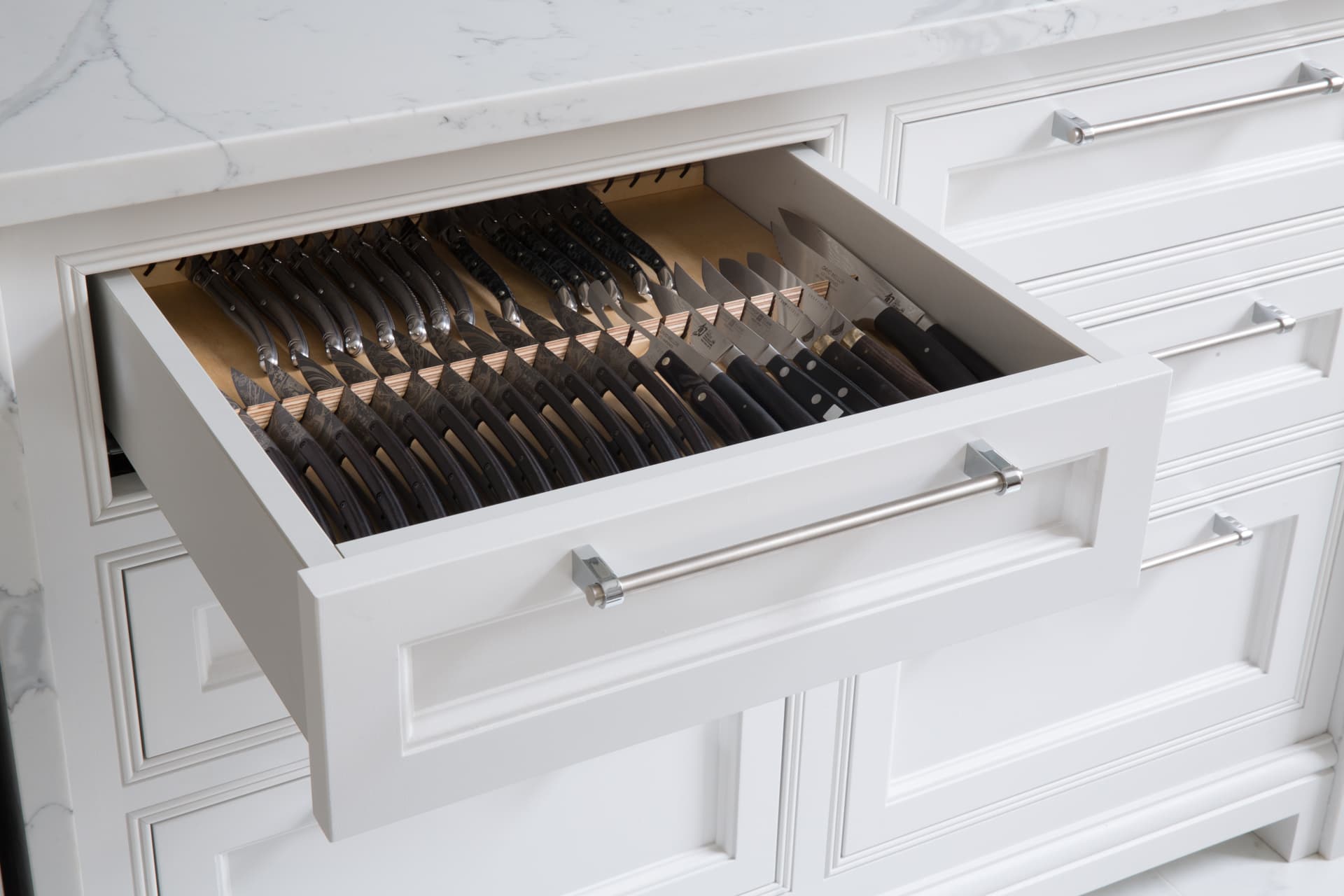
Walk into any antiques showroom and open a drawer in a chest that has been in continuous use since the reign of George III. It will still glide. The joints at its corners — hand-cut dovetails, almost certainly — will be as tight as the day they were made. Two and a half centuries of daily use, and the joinery hasn't flinched.
Now open a drawer in an average modern kitchen. Listen to the wobble. Notice the chipboard. Give it five years, perhaps ten, and those cam-lock fixings will have loosened enough that the whole thing needs replacing.
The difference between these two experiences is joinery. Not the timber, not the finish, not the hardware — though all of those matter — but the way the pieces are joined together. In a bespoke kitchen, joinery is not a hidden detail. It is the single most important factor in determining whether your kitchen will last a decade or a lifetime.
What Joinery Means in a Kitchen Context
Joinery, in the broadest sense, is the craft of connecting pieces of timber to create something larger and more useful than its component parts. It is distinct from carpentry (which deals with structural timber) and from cabinet-making (which is the broader discipline of constructing furniture and fitted work). Joinery is specifically the art of the joint itself.
In a kitchen, joinery is everywhere. It is in the corners of every drawer box, in the frame of every door, in the construction of every carcass, and in the assembly of every panel. Some of these joints bear enormous loads — a base cabinet carrying a stone worktop, for instance, must support several hundred kilograms without complaint. Others must resist repetitive stress: a drawer opened and closed fifteen thousand times a year needs joints that won't loosen, shift, or fail.
The joinery techniques a maker selects for each of these tasks reveal almost everything about the quality of the finished kitchen. A workshop that uses dovetails where dovetails are needed, mortise and tenon where strength demands it, and simpler joints where they are perfectly adequate is a workshop that understands its craft. A workshop that uses the same screws and dowels for everything is cutting corners — sometimes literally.
The Key Joint Types in Bespoke Kitchen Making
Every joint in a well-made kitchen is there for a reason. The following are the principal techniques you'll encounter in genuinely bespoke work, along with the rationale for each.
Dovetail Joints
The dovetail is the aristocrat of joinery, and for good reason. A series of fan-shaped tails on one board interlock with corresponding pins on the other, creating a joint that is mechanically self-locking. Even without glue, a well-cut dovetail cannot be pulled apart in the direction of use. This is elementary physics, and it has made the dovetail the default choice for drawer construction since the sixteenth century.
There are two principal variations used in kitchen work:
Through dovetails are visible from both faces of the joint. The end grain of the pins shows on the front face of the drawer, making the construction method entirely visible. Through dovetails are used on drawers where the maker wants to celebrate the joinery — in a kitchen with natural timber drawer fronts, for instance, or where the drawer interior is intended as a design feature in its own right.
Half-blind dovetails are visible from one side only. The pins are cut short so that the front board conceals them, presenting a clean face while the interlocking joint does its work behind. This is the more common choice for kitchen drawers, particularly those with painted or veneered fronts, where a seamless exterior is part of the design intent.
At Albury House, we use half-blind dovetails as standard on every drawer box. The joint is cut on precision machinery and hand-finished to ensure a perfect fit. It is one of those details that most people never notice — until they compare it with a drawer built any other way.
Mortise and Tenon
If the dovetail is the joint of choice for drawers, the mortise and tenon is its counterpart for frames. A rectangular projection (the tenon) fits into a corresponding rectangular hole (the mortise), creating a joint of enormous strength that resists both racking and twisting forces.
In kitchen work, the mortise and tenon appears most prominently in face-frame construction. The horizontal rails and vertical stiles that make up a kitchen's front framework are joined at every intersection with a mortise and tenon, providing the rigid skeleton on which doors, drawers, and panels all depend. A face frame held together with mortise-and-tenon joints will remain square and true for decades; one assembled with pocket screws or biscuits has considerably less structural integrity.
Mortise-and-tenon joints also form the backbone of frame-and-panel door construction — a subject we shall return to shortly.
Tongue and Groove
Tongue and groove is the workhorse joint of panelling. A continuous ridge (the tongue) on the edge of one board slots into a corresponding channel (the groove) on the adjacent board, allowing multiple boards to be aligned and connected across a surface.
In bespoke kitchens, you will find tongue-and-groove construction in panelled end panels, the backs of dresser units, larder interiors, and boot room and utility cladding. The beauty of the joint is that it accommodates timber movement — each board can expand and contract fractionally within the groove without opening a gap or buckling the surface.
Biscuit Joints
Biscuit joinery uses a compressed beech wafer — shaped like a small oval biscuit — glued into matching slots in two adjoining boards. When the glue meets the compressed biscuit, it swells to fill the slot, creating a surprisingly strong bond.
Biscuit joints are used in carcass assembly for aligning panels, in worktop fabrication where solid timber sections need edge-joining, and in situations where speed and alignment matter more than the sheer mechanical strength of a dovetail or mortise and tenon. They are a perfectly legitimate technique in the right context. Where they become a problem is when they are used as a substitute for stronger joints in places that demand them — drawer corners being the classic example.
Dowel Joints
Dowel joinery uses cylindrical timber pegs glued into matching holes in both halves of a joint. It is one of the oldest joining techniques known and remains common in carcass construction, where the forces are primarily compressive. A well-executed dowel joint — with accurately bored holes and tight-fitting fluted dowels — provides good strength and excellent alignment.
Many reputable bespoke workshops use dowels for carcass assembly, reserving dovetails for drawers and mortise and tenon for frames. This is a sensible and honest hierarchy: the joint is matched to the structural demand of the task.
Pocket Screws
Pocket-screw joinery drives a screw at an angle through a pre-drilled pocket hole, pulling two pieces of timber together. It is fast, requires minimal skill, and provides adequate holding power for certain applications.
In bespoke kitchen work, pocket screws have a limited but legitimate role — securing internal bracing, fixing plinths, and attaching components that may need to be removed for servicing. Where they should not appear is in the primary structural joints of face frames, door construction, or drawer boxes. If you open a drawer and find pocket-screw heads in the corners, the maker has prioritised speed over longevity.
The Dovetail Drawer: Hallmark of Quality
If there is one detail that separates a genuinely handmade kitchen from one that merely claims the title, it is the drawer. Drawers take more punishment than any other component in a kitchen. They are pulled, pushed, loaded, and slammed thousands of times a year. The joinery at their corners must withstand all of this without loosening.
A dovetail drawer, built from solid timber — typically maple, oak, or birch — and mounted on quality full-extension runners, will outlast the kitchen it sits in. The interlocking joint distributes stress across a large glue area and physically cannot separate under normal use. The solid timber box, unlike its chipboard or MDF equivalent, can be sanded, refinished, and even repaired if damaged.
This is why we consider the dovetailed drawer non-negotiable. It is the single component where quality of joinery is most directly felt by the person using the kitchen — every morning, every evening, year after year. If a kitchen maker cuts corners anywhere, the drawer is the first place it shows.
Frame-and-Panel Construction for Doors
Kitchen doors are subject to a particular challenge that other joinery must contend with: timber movement. Solid timber expands and contracts across the grain as humidity changes with the seasons. A door made from a single wide board would warp, cup, and eventually crack. Frame-and-panel construction solves this problem with elegant simplicity.
A solid timber frame — two vertical stiles and two horizontal rails, joined at each corner with a mortise and tenon — surrounds a thinner central panel. The panel sits in a groove within the frame but is not glued in place. It floats, free to expand and contract with seasonal humidity changes without distorting the frame or cracking itself.
This method has been used in English architectural woodwork since the medieval period, and for good reason: it works. A frame-and-panel door built with properly cut mortise-and-tenon joints and a free-floating panel will remain flat, stable, and beautiful for the life of the kitchen. It is the construction method behind the in-frame kitchens and Shaker-style designs that define the English tradition of bespoke cabinetry.
The panel itself may be flat, raised, or profiled, depending on the style. What matters structurally is that it floats. Glue a panel into its frame — as some less experienced workshops do — and you are almost guaranteed cracks within a few years as the timber tries to move and finds it cannot.
How to Spot Quality Joinery
You don't need a woodworking qualification to assess the quality of kitchen joinery. You need your eyes, your fingers, and a willingness to open drawers and look closely.
Open a drawer. Look at the corners. If you can see interlocking dovetail pins and tails — crisp, tight-fitting, with no visible gaps — you are looking at quality construction. If you see screws, staples, or plastic corner blocks, the drawer has been assembled rather than joined.
Run your fingers along the joints. Quality joinery is flush. There should be no ridges where one piece meets another, no steps, no rough spots. The transition from one timber surface to the next should feel seamless.
Check the interior finish. A maker who builds quality joinery will also finish the interior of the cabinet properly. Look for sanded surfaces, sealed or finished timber, and clean, precise cuts. Rough interiors suggest that attention was not a priority.
Examine the doors. In a frame-and-panel door, the joints at each corner should be tight and gap-free. The panel should not rattle or feel loose — but it should have enough room to move fractionally within the groove. If the frame joints are pulling open, or if the door is distorting, the joinery is failing.
Ask to see an unfinished sample. Any confident maker will happily show you the construction behind the paint. If a workshop is reluctant to show you the bones of their work, there may be a reason.
Hand-Cut vs Machine-Cut Joints
There is a romantic notion that hand-cut joints are inherently superior to machine-cut ones. The reality is more nuanced.
A hand-cut dovetail, marked out with a gauge and cut with a fine-toothed saw, has a character that is unmistakable. The pin spacing may vary slightly; the angles will be consistent but not robotically uniform. An experienced eye can distinguish a hand-cut joint at a glance, and there is an undeniable satisfaction in knowing that a craftsperson's hands shaped every surface.
A machine-cut dovetail, produced on a precision router jig or a CNC machine, is a different proposition. The pins and tails are perfectly uniform, the fit is consistently tight, and the production time is a fraction of the hand-cut equivalent. Structurally, the two are indistinguishable. A well-machined dovetail is every bit as strong as a hand-cut one.
Where the distinction matters is in the character of the piece. Hand-cut joints carry the subtle imperfections that mark them as the work of a human hand. They connect the kitchen to a tradition of craft that stretches back centuries. For clients who value that connection — and who appreciate the additional hours of skilled labour it represents — hand-cut joinery is a meaningful upgrade.
At Albury House, our standard drawer dovetails are precision-machined and hand-finished. For clients who want the full hand-cut experience, we offer it — and the workshop rather enjoys the excuse to put down the router and pick up a dovetail saw.
Modern Machinery Alongside Traditional Techniques
There is a misconception that bespoke kitchen making is — or should be — an entirely hand-tool affair. This is charming but impractical. The reality in any serious modern workshop is a thoughtful marriage of traditional joinery techniques and precision machinery.
Our CNC router can cut a mortise with tolerances of a tenth of a millimetre — a level of consistency that even the most skilled hand-tool user cannot sustain across hundreds of identical joints. Our spindle moulder profiles door frames with a precision and repeatability that would take hours to achieve by hand. Our thicknessing machines prepare timber stock to exact dimensions across long runs, ensuring every component starts from the same baseline.
What machinery does not do is replace judgement. A CNC machine cannot assess a board for grain direction, decide where a knot should fall in a door panel, or feel whether a joint is truly tight. These decisions — the ones that determine the character and integrity of the finished piece — remain firmly in the hands of the maker.
The best bespoke workshops use machinery to handle the repetitive, precision-critical tasks, freeing their craftspeople to spend time on the work that genuinely requires a human touch: fitting, finishing, and the thousand small decisions that accumulate into something that feels made rather than manufactured. It is this balance that distinguishes a modern bespoke kitchen from both a factory product and a museum piece.
Why Joinery Quality Determines Kitchen Longevity
A kitchen is not a static object. It lives in a house, and a house is a dynamic environment. Humidity fluctuates with the seasons. Central heating switches on and off. Timber absorbs moisture in the summer and releases it in the winter, expanding and contracting in a constant, imperceptible cycle.
Mechanical fixings — screws, cam locks, staples — cannot accommodate this movement gracefully. Each cycle of expansion and contraction works the fixing slightly, loosening its grip by fractions of a millimetre. Over years, those fractions accumulate. Drawers begin to wobble. Doors drop on their hinges. Carcasses rack and twist. The kitchen that felt solid and precise at installation slowly, quietly, falls apart.
Properly made joints tell a different story. A dovetail accommodates timber movement because both halves of the joint move together — they are, after all, made of the same material. A mortise and tenon, correctly fitted with a fraction of allowance, permits the timber to breathe without compromising the integrity of the frame. A floating panel expands and contracts within its groove without cracking or distorting.
This is why a kitchen built with sound traditional joinery will comfortably last thirty to fifty years. It is why Georgian furniture still works. And it is why, for us, the quality of joinery is not a selling point or a marketing distinction — it is simply the way things ought to be done.
A Day in the Workshop
It is half past seven, and the workshop is already warm. The dust extraction hums into life. Coffee is poured. Somewhere in the machine shop, the CNC router begins its first programme of the day — cutting a batch of carcass panels with the methodical precision that only a machine can sustain at scale.
In the bench room next door, the atmosphere is quieter and the pace more deliberate. A cabinetmaker is dry-fitting a face frame, checking each mortise-and-tenon joint for tightness before committing to glue. He adjusts the fit on one joint with a few passes of a shoulder plane, offers it up again, and nods. Across the bench, a colleague is marking out dovetails on a run of drawer sides — the pencil lines crisp and confident from years of repetition.
By mid-morning, the first carcasses are being assembled. Dowels are glued, panels are squared, and clamps are tightened with the practised rhythm of work that has been done the same way, in the same manner, by the same sort of people, for a very long time. There is nothing hurried about it. The glue needs twenty minutes to cure. The tea needs four.
After lunch, attention turns to the doors. Frame components arrive from the spindle moulder with their profiles already cut. Each frame is assembled with its mortise-and-tenon joints, the panel offered into its groove, and the whole thing clamped and checked for square. A frame that is out of square by even half a millimetre is taken apart and refitted. There is a saying in the workshop: the door doesn't know what time it is. It will take as long as it takes.
By late afternoon, finished components are stacked on racks, each one labelled with the client's name and the position it will occupy in the finished kitchen. A set of dovetailed drawers sits in a neat row, their joints tight and clean, ready for sanding and finishing. They don't look particularly dramatic. They are simply well made — which is, when you think about it, the most dramatic thing a kitchen component can be.
Investing in Joinery That Lasts
If you are commissioning a bespoke kitchen, the joinery behind it deserves your attention. It is not the glamorous part of the process — nobody photographs dovetail joints for Instagram with quite the same enthusiasm as they photograph marble worktops — but it is the part that will determine whether your kitchen is still working beautifully in twenty years.
Ask your maker about their joinery. Ask to see examples. Ask to visit the workshop. A maker who is proud of their construction will welcome the enquiry. A maker who deflects it may not want you looking too closely.
At Albury House, we rather enjoy the question. Our bespoke cabinets are built to be examined, because there is nothing hidden in their construction that we wouldn't happily show you. The joints are tight. The timber is solid. And the kitchen, we trust, will still be opening and closing with quiet satisfaction long after we've all retired.
If you would like to see our joinery for yourself — or simply to talk about what a bespoke kitchen might look like in your home — we would be delighted to hear from you. Get in touch and we will arrange a visit.
Frequently Asked Questions
Thinking about a new kitchen?
Book Your Free ConsultationYou might also enjoy
Bespoke Kitchen Cabinets: The Definitive Guide to Handmade Cabinetry
Everything you need to know about bespoke kitchen cabinets — from construction methods and timber selection to door styles, finishes, and the details that distinguish genuine craftsmanship from the merely expensive.
The Bespoke Kitchen Design Process: From Brief to Blueprint
How does a bespoke kitchen get designed? We walk through every stage of the design process — from developing the brief and spatial analysis to 3D visualisation, technical drawings, material specification, and sign-off.
How Much Does a Bespoke Kitchen Cost in the UK? A Transparent Guide
A straightforward breakdown of bespoke kitchen cost in the UK — what drives the price, what to budget for, and why the investment is worth every penny. No vague ranges, no hard sell.