

Hand-Painted Kitchen Cabinets: A Complete Guide to the Finest Finish in British Cabinetry
Everything you need to know about hand-painted kitchen cabinets in the UK — from preparation and paint selection to colour choices, durability, and why hand-painting remains the gold standard for bespoke kitchens.
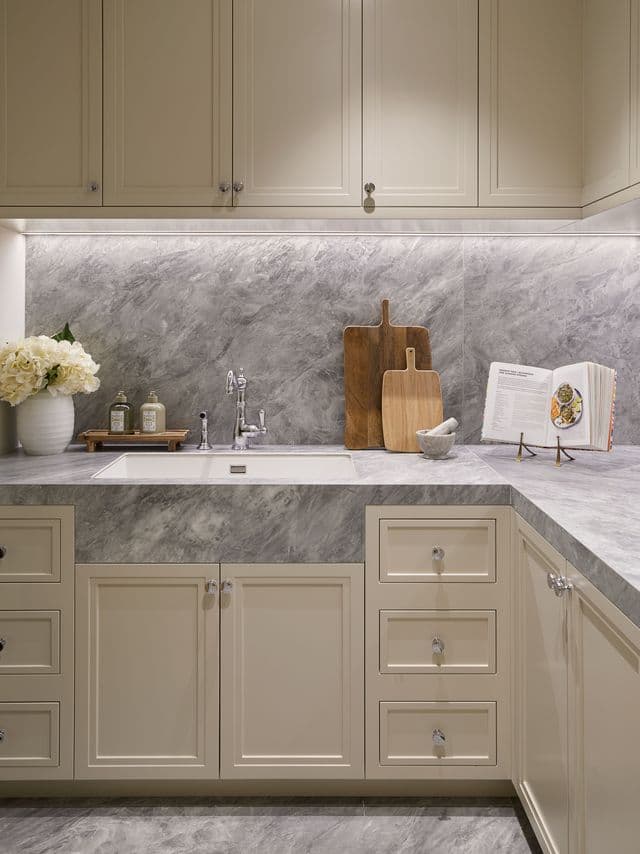
There is a particular quality to a hand-painted kitchen that photographs struggle to capture. It is the way light moves across the surface — not bouncing off a uniform, factory-perfect plane, but settling into the subtle undulations left by a skilled painter's brush. Stand close and you see the texture. Step back and you see depth: a richness of colour that flat, sprayed finishes simply cannot replicate.
Hand-painted kitchen cabinets have been the standard of fine English cabinetry for centuries, and despite every advance in spray technology and factory finishing, they remain the choice of makers and homeowners who value character over clinical perfection. There are good reasons for this, and they go well beyond aesthetics.
This guide explains what hand-painting actually involves, why preparation matters more than the paint itself, how to choose the right colour and finish, and what to expect from bespoke kitchen cabinets that have been painted by hand.
What Hand-Painting Actually Involves
If you imagine a painter arriving with a tin of paint and a brush, applying a couple of coats, and heading home for tea — think again. A proper hand-painted finish on kitchen cabinetry is a painstaking, multi-stage process that typically takes two to three weeks for a full kitchen.
The sequence, in its simplest form, runs as follows:
- Preparation of bare timber — sanding to a smooth, even surface, filling any minor imperfections, and ensuring the grain is raised and re-sanded so it won't telegraph through the paint later.
- Application of specialist primer — a bonding primer formulated for the timber species and paint system being used, applied evenly and allowed to cure fully.
- Light sanding — the entire surface is hand-sanded with fine-grit paper to create a key for the next coat and remove any nibs or dust particles.
- First undercoat — applied by brush, working the paint into every moulding profile, panel edge, and corner. Dried and cured.
- Further sanding — again, every surface, by hand.
- Second undercoat — building opacity and depth. Dried and cured.
- Further sanding — yes, again.
- Topcoat — the final, visible coat, applied with great care using the finest brushes, maintaining a wet edge to avoid lap marks, and working methodically to ensure even coverage.
Some painters apply a second topcoat for particularly demanding environments or dark colours that require greater opacity. Each sanding stage is done by hand rather than machine, because the human touch responds to the surface in a way that a random-orbit sander cannot — feeling for nibs, easing edges, maintaining the crispness of moulding details.
The entire process means that a single kitchen door may be handled, sanded, coated, and inspected six or more times before it is considered finished. This is not efficiency. This is craft.
The Preparation Question
Ask any experienced kitchen painter what matters most and you will hear the same answer: preparation. It is not the glamorous part of the job. It is not what clients photograph for their Instagram accounts. But it is, without exaggeration, eighty per cent of the work — and the difference between a finish that lasts five years and one that lasts twenty-five.
Preparation begins with the timber itself. At Albury House, our cabinetmakers select tulipwood for hand-painted work because its fine, even grain produces a flawless surface under paint. The timber is kiln-dried to a precise moisture content, then allowed to acclimatise in our workshop before any work begins. Rushing this stage — as volume producers must — leads to movement, cracking, and paint failure down the line.
Every surface is sanded through a progression of grits, each finer than the last. Any knots are sealed. Any filler is applied proud and sanded flush. The goal is a surface that is perfectly smooth, uniformly absorbent, and completely free of contamination. Only then does the primer go on.
The primer itself is chosen to suit the timber and the topcoat system. An alkali-resisting primer might be used over knotty sections. A high-build primer provides additional body over open-grained timbers. The primer must bond tenaciously to the wood and provide a stable foundation for every subsequent coat.
Between each coat — primer, undercoat, topcoat — the surface is sanded again. This serves two purposes: it creates a mechanical key for the next coat to grip, and it removes any imperfections that have appeared during drying. A speck of dust landing on wet paint, a single brush hair, a tiny sag in a corner — all are addressed at this stage. The result, after six or seven iterations of this process, is a surface of remarkable smoothness and consistency.
Spray vs Brush: The Great Debate
The question of whether to spray or brush-paint kitchen cabinets provokes strong opinions on both sides. Let us offer a balanced view before explaining why we lean the way we do.
Sprayed finishes are applied using a pressurised gun in a controlled environment, typically a dedicated spray booth. The result is a perfectly smooth, uniform surface with no brush marks, no texture, and no visible evidence of human involvement. Modern two-pack polyurethane spray finishes are extremely hard-wearing and resist moisture, heat, and chemical attack admirably. For sleek, contemporary kitchens with flat-panel doors and handleless designs, spraying is often the logical choice.
Hand-painted finishes are applied by brush (occasionally supplemented with a small roller for large flat panels). The result is subtly different. There is a warmth and depth to a brushed finish — an almost imperceptible texture that catches the light differently as you move around the room. The paint sits in the grain, fills the moulding profiles, and creates a surface that has visual depth rather than clinical uniformity.
For bespoke in-frame kitchens and Shaker-style designs, hand-painting is the more sympathetic choice. The slight texture of a brushed finish complements the handmade character of the cabinetry. A perfectly sprayed surface on a hand-cut in-frame kitchen can feel oddly at odds with itself — as though the maker built something by hand and then tried to disguise the fact.
There is also the practical matter of repairability. A hand-painted finish can be touched up, sanded back, and recoated — section by section, door by door — throughout the life of the kitchen. A sprayed finish, particularly a two-pack lacquer, cannot be locally repaired without visible evidence. Any damage typically requires the affected component to be removed, taken back to bare timber, and re-sprayed in a booth. This is expensive, time-consuming, and often means your kitchen is missing a door for a fortnight.
Choosing Your Paint
The paint you select for hand-painted kitchen cabinets matters enormously — not just for colour, but for durability, workability, and the quality of the finished surface. The UK market offers several outstanding options.
Farrow & Ball
The name most readily associated with painted kitchens, and for good reason. Farrow & Ball's Modern Eggshell is formulated specifically for woodwork and cabinetry. It is water-based (making it low-odour and fast-drying), extremely durable, and available in their full range of characterful, deeply pigmented colours. The finish has a gentle sheen that shows colour beautifully without appearing glossy. For traditional and country kitchens, Farrow & Ball remains the benchmark.
Little Greene
Little Greene offers an intelligent Paint range alongside their more traditional oil-based options. Their Intelligent Eggshell is a hybrid formulation that combines the easy application of a water-based paint with the tough, levelling properties traditionally associated with oil-based finishes. The colour range is exceptional — deeply researched, historically informed, and notably more nuanced than most competitors.
Mylands
A lesser-known name outside the trade, Mylands has been making paint in London since 1884. Their Wood & Metal Eggshell is highly regarded among professional kitchen painters for its excellent flow, levelling, and durability. The colour palette is sophisticated and distinctly metropolitan — think deep, complex neutrals and rich, saturated accent colours.
Dulux Heritage
For those who want a broader colour range and slightly easier availability, Dulux Heritage offers a credible alternative. The Velvet Matt and Eggshell finishes are well-suited to cabinetry, and the Heritage palette includes a number of colours that sit beautifully in kitchen settings. It is a more accessible option without compromising on quality.
A Note on Oil-Based Paints
Traditional oil-based paints — the eggshells and satinwoods that your grandmother's kitchen painter would have used — are increasingly rare in modern kitchen work. They offer superb durability and a beautiful, self-levelling finish that many painters still prefer. However, they take considerably longer to dry (sometimes 24 hours between coats), carry a strong odour, and have higher VOC content. Modern water-based formulations from the brands above have closed the performance gap significantly, and most contemporary bespoke kitchens are now finished in water-based eggshell.
Choosing the Right Colour
Colour selection is where many clients feel most uncertain — and most excited. A hand-painted kitchen in the right colour transforms a room. In the wrong colour, it dominates it.
The Cardinal Rule: Sample in Your Space
Never choose a kitchen colour from a paint chart, a website, or someone else's kitchen. Paint behaves differently in every room, shifting dramatically with light direction, time of day, and the colours surrounding it. A warm grey that looks calm and elegant in a south-facing showroom may appear cold and institutional in a north-facing kitchen.
Order sample pots. Paint large swatches — at least A3 size — on card or directly onto the wall. Live with them for a week. Observe them in morning light, afternoon light, artificial light. Notice how they change. The colour you love at eleven o'clock on a sunny morning is the same colour you'll be looking at on a dark January evening. Make sure you can live with both.
Popular Colour Families for Kitchens
Warm whites and off-whites remain perennially popular, and for good reason. Colours like Farrow & Ball's Pointing, Little Greene's Flint, or a bespoke off-white mixed to complement your worktop offer a timeless foundation that works with virtually any interior scheme. These are not boring choices — the depth and warmth of a hand-painted off-white is worlds apart from a sprayed brilliant white.
Soft greens have surged in popularity and show no sign of retreating. Sage, olive, and muted verdigris tones connect a kitchen to its garden and landscape. They sit beautifully alongside natural stone, oak, and brass hardware. Farrow & Ball's Vert de Terre, Little Greene's Aquamarine, and a number of bespoke greens are among the most requested colours in our workshop.
Blues offer a striking counterpoint to warm timber and stone. Navy and midnight blues create drama on an island or dresser, whilst softer duck-egg and grey-blues provide a gentler backdrop for the full kitchen. Blue is a confident choice that rewards careful specification.
Dark neutrals — charcoal, slate, deep taupe — are increasingly popular for contemporary bespoke kitchens. They create a powerful sense of enclosure and calm, particularly in larger rooms where an all-white scheme might feel sparse. These colours show the depth of a hand-painted finish at its absolute best.
Two-tone schemes — a darker island with lighter perimeter cabinetry, or painted base units with natural timber wall cabinets — have become a design staple. They add visual interest, define zones within an open-plan space, and allow clients who cannot commit to a single bold colour to introduce it in a manageable dose.
The Durability Question
One of the most common concerns about hand-painted kitchen cabinets is durability. Will the finish chip? Will it mark easily? Will it need repainting in five years?
The honest answer is that a properly prepared and painted kitchen, using the right paint on the right timber, will last remarkably well. Fifteen to twenty years is a realistic expectation for a topcoat before it needs more than occasional attention. Many of our earlier kitchens are approaching that age and still look handsome.
Kitchen cabinetry does, inevitably, see wear. The areas around handles accumulate fingerprints and the occasional scuff. Drawers that are opened ten times a day will eventually show their use at the edges. This is not failure — it is patina, the gentle evidence of a kitchen that is used and loved rather than preserved behind glass.
When the time does come for a refresh, hand-painted cabinets offer something that no other finish can match: they can be repainted. A light sand, a fresh topcoat, and the kitchen is renewed. The colour can even be changed entirely, giving the room a completely different character without replacing a single cabinet. Try doing that with a sprayed two-pack lacquer or a vinyl-wrapped door.
Touch-Ups and Maintenance
The day-to-day maintenance of hand-painted kitchen cabinets is refreshingly simple. Wipe down with a damp cloth and a mild detergent. Avoid abrasive cleaners and scourers. That is essentially it.
For minor chips and scuffs — an inevitability in a busy family kitchen — keep the small pot of touch-up paint that any good maker will supply with your kitchen. A tiny brush and a steady hand will address most minor damage invisibly. For areas of heavier wear, a professional painter can sand back and recoat individual doors or panels on site, typically in a day, with minimal disruption.
The ability to maintain, repair, and refresh a hand-painted finish over time is one of its most compelling practical advantages. It is why painted kitchens are so well-suited to the demands of real family life — and why they age so gracefully compared to factory finishes that look perfect on day one and deteriorate steadily from day two.
Factory-Painted vs Site-Painted
Bespoke kitchen cabinets can be hand-painted in the workshop before delivery, on site after installation, or — most commonly — using a combination of both approaches.
Workshop painting allows the painter to work in controlled conditions: consistent temperature and humidity, good light, and the ability to position components flat for optimal paint flow. Carcass interiors, drawer boxes, and the backs of doors are typically painted in the workshop. The disadvantage is that painted components must then be transported, handled, and installed without damage — no small feat.
Site painting happens after installation, when all cabinetry is in position. This allows the painter to ensure perfect colour continuity across the kitchen, to paint the face frames in situ (where they will be seen), and to address any minor marks from the installation process. It does, however, require the painter to work around gravity, access constraints, and the other trades finishing the room.
The best bespoke kitchens typically use both approaches. Components are primed and undercoated in the workshop, transported with care, installed, and then the final topcoats are applied on site by the painter who prepared the surfaces in the first place. This ensures continuity and accountability — one pair of hands responsible for the finish from start to finish.
Cost Implications
Hand-painting is more expensive than factory spraying. There is no way around this, and it would be disingenuous to suggest otherwise. The additional cost reflects the time involved — a skilled painter, working methodically through multiple coats and sanding stages over two to three weeks, is a significant investment.
As a general guide, hand-painting adds between ten and twenty per cent to the cost of a kitchen compared with a sprayed finish. On a kitchen costing £80,000 to £120,000, that might represent an additional £8,000 to £20,000 depending on the complexity of the design, the number of coats specified, and the paint brand selected.
Whether this represents good value depends on your priorities. If you value the depth, character, and repairability of a hand-painted finish — and if you intend to live with your kitchen for fifteen years or more — the premium is modest relative to the total investment. If you prefer a sleek, uniform finish and are less concerned with long-term repairability, a high-quality spray finish may serve you equally well.
Why Hand-Painting Suits Bespoke
There is a philosophical alignment between hand-painted finishes and bespoke kitchen cabinetry that goes beyond mere tradition. Both are about the primacy of the human hand. Both accept — indeed celebrate — the subtle variations that distinguish handmade from machine-made. Both prioritise longevity and repairability over disposable perfection.
A bespoke kitchen is designed and built around the specific dimensions, features, and character of your room. Each cabinet is made individually. Each door is fitted to its frame by hand. The joinery is cut, assembled, and finished by a craftsperson who can see and feel what they are making. To then finish this work with a robotic spray process feels, to us, like writing a letter by hand and then photocopying it.
Hand-painting honours the making. The painter responds to the surface — adjusting pressure, varying speed, working the paint into mouldings and profiles with a sensitivity that no spray gun can replicate. The result is a finish that belongs to its cabinetry, that feels of a piece with the craftsmanship underneath.
This is not to say that spraying has no place in fine kitchen making. For contemporary designs with flat, handleless doors, a precision-sprayed finish can be exactly right. But for the English country kitchens, classic in-frame designs, and heritage-influenced schemes that form the heart of our work at Albury House, hand-painting remains the only finish that does the cabinetry justice.
Making the Decision
If you are considering hand-painted kitchen cabinets for your home, the decision rests on a few honest questions. Do you value character and depth over clinical uniformity? Are you comfortable with a finish that will develop a gentle patina over time? Do you want the option to refresh or change your kitchen's colour in ten or fifteen years without replacing the cabinetry?
If the answer to these questions is yes, hand-painting is almost certainly the right choice.
The next step is finding a maker who understands the process from timber selection through to the final topcoat — and who employs or works closely with painters of genuine skill. The relationship between cabinetmaker and painter is critical. The best results come from teams who have worked together for years, who understand each other's standards, and who take collective pride in the finished kitchen.
We would be delighted to show you the difference in person. Our workshop near Bishop's Stortford is open for visits, and there is no better way to understand the quality of a hand-painted finish than to see it, touch it, and compare it with the alternatives.
Get in touch to arrange a visit and see what hand-painted kitchen cabinets look like when they're done properly.
Frequently Asked Questions
Thinking about a new kitchen?
Book Your Free ConsultationYou might also enjoy
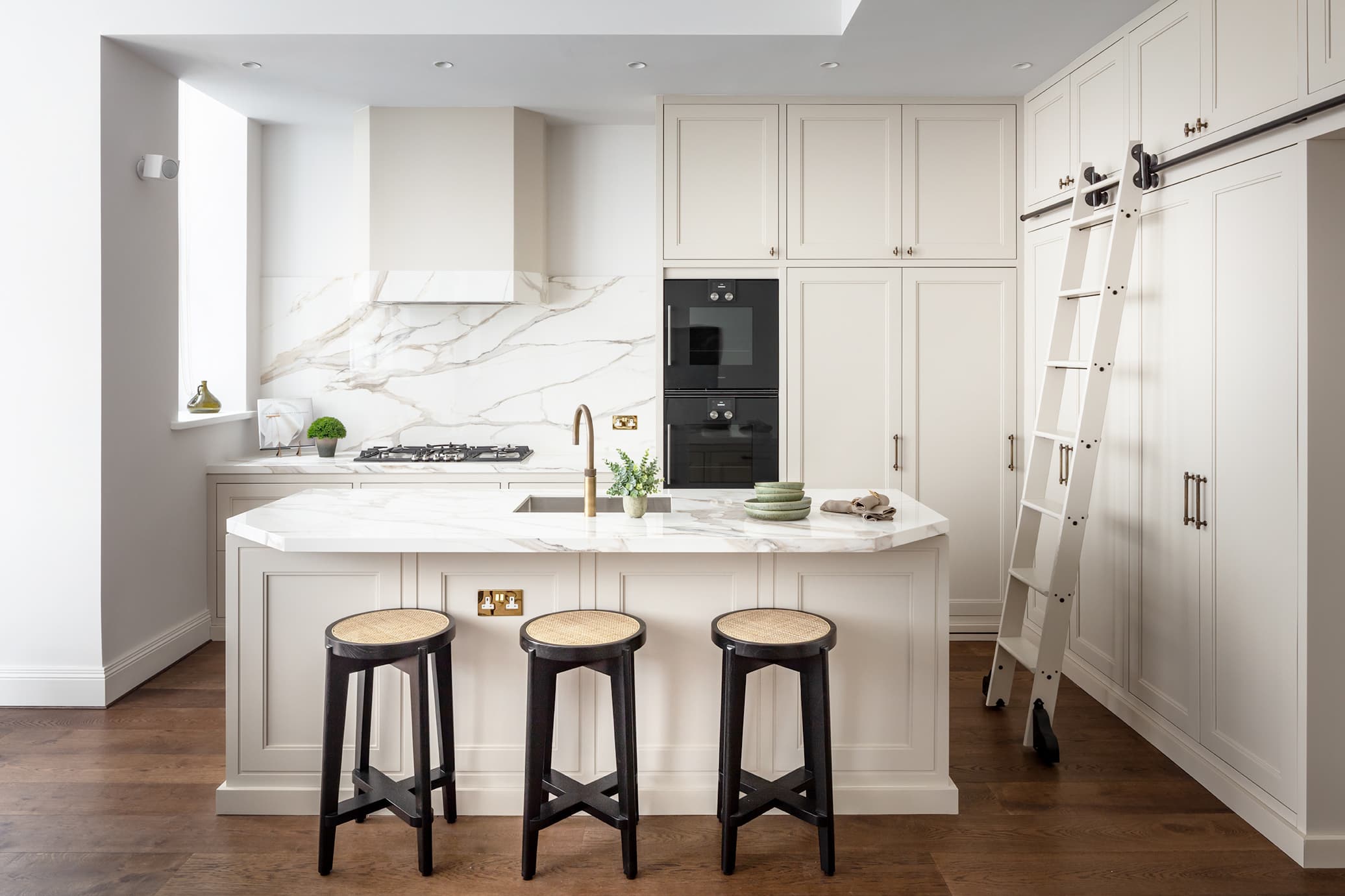
Bespoke Kitchen Cabinets: The Definitive Guide to Handmade Cabinetry
Everything you need to know about bespoke kitchen cabinets — from construction methods and timber selection to door styles, finishes, and the details that distinguish genuine craftsmanship from the merely expensive.
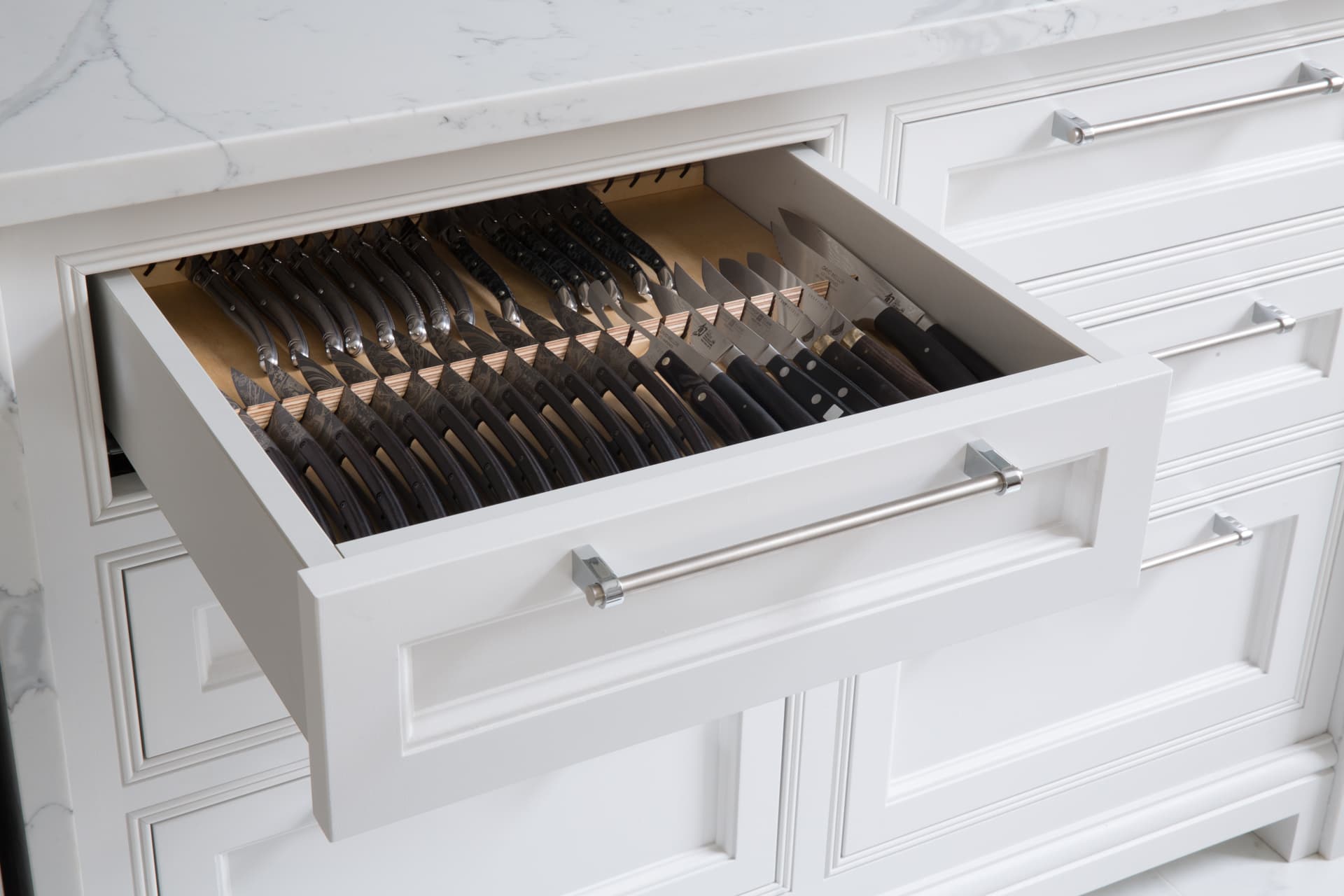
Bespoke Kitchen Joinery: The Craft Behind Cabinets That Last Generations
A detailed guide to the joinery techniques used in bespoke kitchen craftsmanship — from dovetail drawers and mortise-and-tenon frames to tongue and groove panels. Learn how to recognise quality joinery and why it determines how long your kitchen will last.
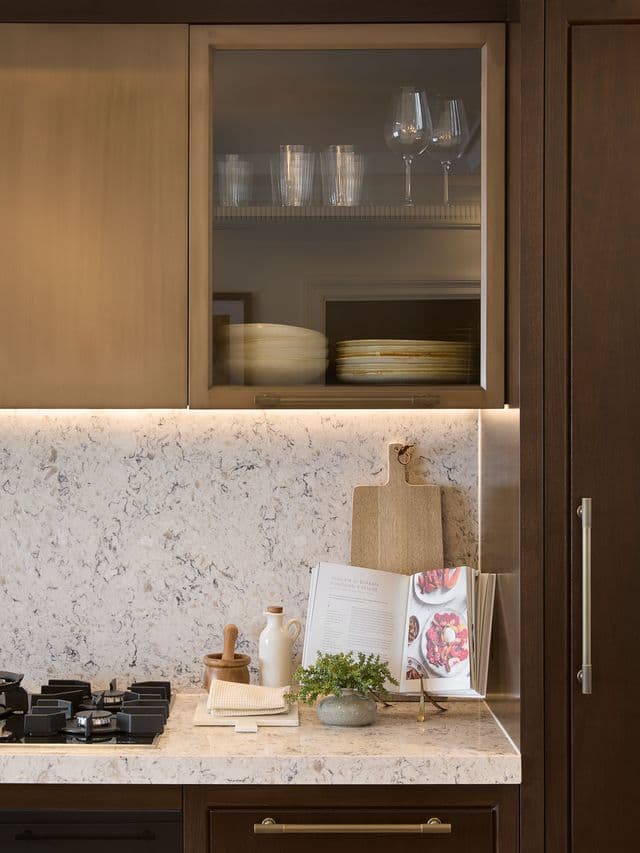
The Bespoke Kitchen Design Process: From Brief to Blueprint
How does a bespoke kitchen get designed? We walk through every stage of the design process — from developing the brief and spatial analysis to 3D visualisation, technical drawings, material specification, and sign-off.