

Walk-In Pantry Design: The Complete Guide to a Kitchen's Most Coveted Room
Everything you need to know about walk-in pantry design — from layout options and shelving to lighting, ventilation, and materials. A guide to creating the pantry your kitchen deserves.
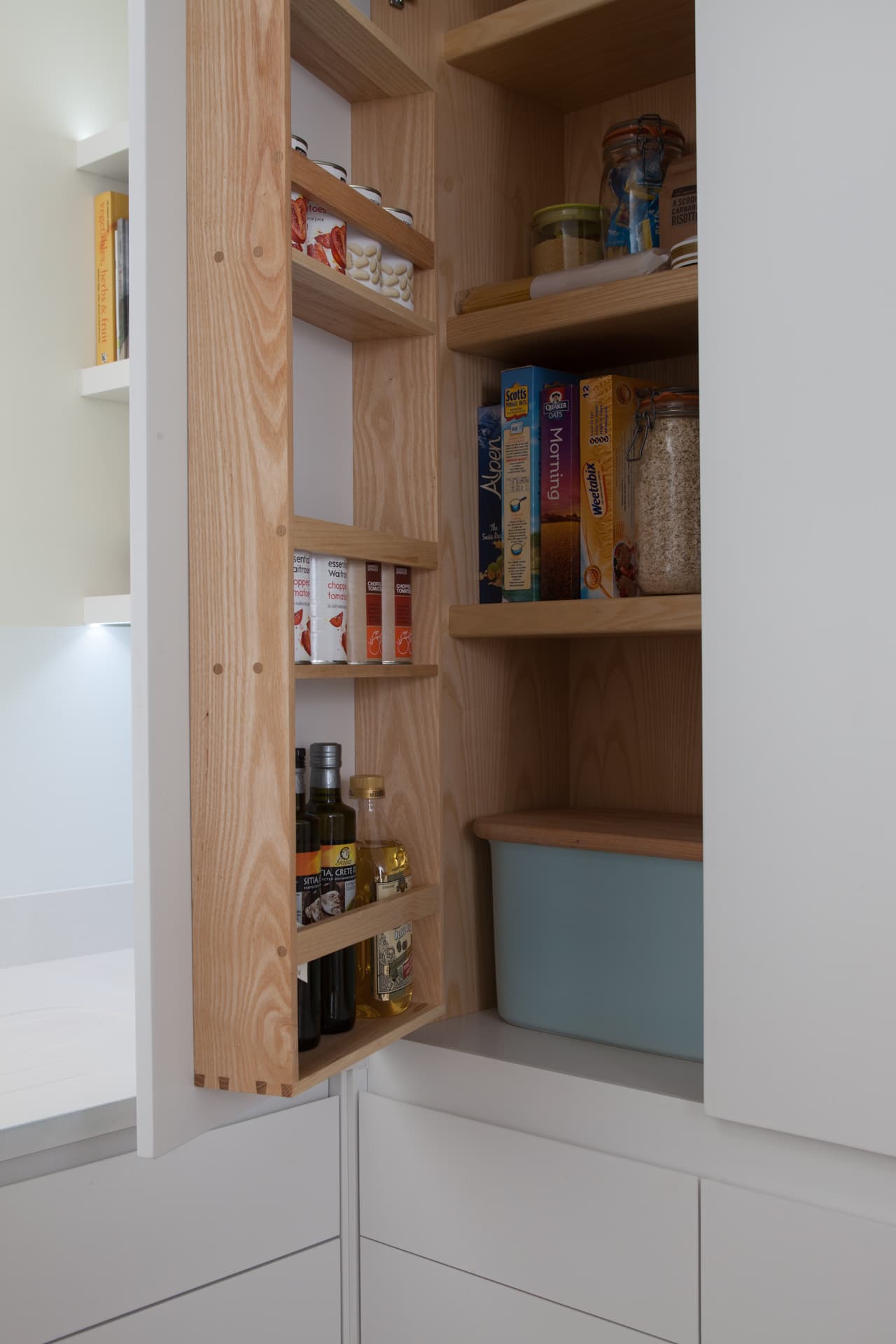
There is a moment, somewhere around the third year of living with a well-designed walk-in pantry, when you realise you could never go back. The cereal is where you expect it. The baking ingredients are at arm's reach. The food processor has a home that is neither the worktop nor a precarious stack at the back of a cupboard. Everything is visible, everything is accessible, and the kitchen — mercifully — is clear.
The walk-in pantry is not a new idea. It is, in fact, a very old one that the twentieth century briefly and regrettably abandoned in favour of wall units. But it is enjoying a renaissance that shows no sign of slowing, and for reasons that go well beyond nostalgia. If you are designing a bespoke kitchen or renovating an existing one, a walk-in pantry may be the single most transformative addition you can make.
This guide covers everything you need to consider — from spatial requirements and layout options to shelving design, materials, lighting, and the not-insignificant question of ventilation.
The Walk-In Pantry Renaissance
For much of the last century, kitchen design was driven by a relentless pursuit of integration. Everything behind a door. Everything flush. The fitted kitchen, for all its virtues, treated storage as a problem to be concealed rather than a system to be celebrated.
The walk-in pantry takes the opposite view. It acknowledges that a busy kitchen generates an enormous volume of stuff — ingredients, appliances, crockery, glassware, table linens, the questionable collection of novelty mugs — and that the most elegant solution is not to cram it into ever-more-ingenious cabinet interiors but to give it a room of its own.
The resurgence has been driven by several converging trends. Open-plan living demands visually uncluttered kitchens, and a pantry allows you to maintain that serenity by moving the working chaos behind a single door. Batch cooking, home baking, and a renewed interest in preserving have created demand for serious food storage that standard cabinetry simply cannot provide. And there is, frankly, a pleasure in a well-stocked pantry that no amount of soft-close drawers can replicate.
For our clients along the M11 corridor — from Cambridge college lodges to Essex farmhouses — the walk-in pantry has become one of the most frequently requested elements in a new kitchen scheme.
Size and Space Requirements
The first question is always: how much space do I actually need?
The answer depends on what you intend to store and how you intend to use the pantry, but some practical minimums apply:
- Minimum viable pantry — 1.5m x 1.8m. Enough for shelving on two walls with a clear central aisle. Functional, if a little snug.
- Comfortable working pantry — 2m x 2.5m. Shelving on three walls, room for a small worktop, and sufficient aisle width for two people to use the space simultaneously.
- Generous pantry or butler's pantry — 2.5m x 3m or larger. Space for full-depth shelving, a secondary sink or worktop, appliance storage, and potentially a wine conditioning unit.
Clear aisle width is the dimension that most affects daily usability. We recommend a minimum of 900mm between facing shelves — enough to open a drawer, crouch to a lower shelf, or pass another person without the awkward sideways shuffle that plagues narrow utility rooms.
Ceiling height matters too. If your ceilings allow it, take shelving to at least 2.1 metres. The upper reaches are perfect for items used infrequently — the Christmas serving platters, the lobster pot, the fondue set you received as a wedding gift and have used precisely once.
Layout Options for Walk-In Pantries
The layout of your pantry should respond to the shape of the available space, the position of the doorway, and how the pantry connects to the main kitchen workflow.
The Galley Pantry
Two parallel runs of shelving with an aisle between them. This is the most space-efficient layout and works beautifully in narrow spaces — converted corridors, former passages between rooms, or spaces carved from the depth of a large kitchen. A galley pantry of just 1.2 metres wide and 2.5 metres deep can provide a remarkable amount of storage.
The L-Shape Pantry
Shelving on two adjacent walls, with the remaining walls free for a doorway and perhaps a small worktop. The L-shape suits corner spaces well and offers the advantage of a clear sightline from the door to the majority of the contents — you can see what you need without stepping fully inside.
The U-Shape Pantry
The gold standard for dedicated pantry rooms. Shelving wraps three walls, providing maximum storage in a compact footprint. A U-shaped pantry of 2.4 by 2 metres will comfortably hold the entire dry goods inventory of a serious home cook, plus small appliances, crockery, and a decent wine collection. The key consideration is aisle width — too narrow and the space feels claustrophobic; too wide and you're wasting valuable shelf area.
The Butler's Pantry
Strictly speaking, a butler's pantry is a distinct concept — a service space between kitchen and dining room, traditionally fitted with a sink, a worktop, and storage for glassware and tableware. It was the staging area where dishes were plated and drinks were poured, out of sight of dinner guests.
In contemporary homes, the butler's pantry has evolved into something more hybrid: a secondary preparation area combined with walk-in storage. It is particularly well suited to homes where entertaining is frequent, allowing the host to prepare, plate, and pour without disrupting the main kitchen. If your kitchen design includes a separate dining room, a butler's pantry positioned between the two is an exceptionally civilised arrangement.
What to Store: Planning Your Pantry Contents
A walk-in pantry earns its keep by housing everything that clutters the kitchen but needs to remain close at hand. The most successful pantries we've designed accommodate:
Dry Goods and Provisions
This is the pantry's primary vocation. Flours, sugars, pasta, rice, tinned goods, oils, vinegars, spices, cereals, baking supplies — the entire inventory of ingredients that fill and overflow conventional kitchen cupboards. Decanting into uniform jars is satisfying but not compulsory; a well-designed pantry should work perfectly well with a mixture of packaging.
Small Appliances
The stand mixer. The food processor. The slow cooker. The bread maker. The juicer that seemed like a good idea. These appliances are essential for some meals and entirely in the way for most others. A pantry with a dedicated appliance zone — ideally at worktop height, with a power socket behind — allows you to keep them accessible without surrendering valuable kitchen worktop space.
Crockery, Glassware, and Serving Pieces
Everyday crockery belongs in the kitchen, close to the dishwasher. But the serving platters, the good glasses, the salad bowls that come out for dinner parties — all of these are perfectly placed in a pantry, where they're easy to reach when needed and entirely out of the way when not.
Wine and Spirits
A walk-in pantry, particularly one with a cool north-facing wall, can provide perfectly respectable conditions for everyday wine storage. For serious collections, a dedicated conditioning unit can be integrated into the pantry design. Open shelving for spirits and a dedicated section for wines-in-waiting creates what is essentially a private cellar within your kitchen footprint.
Overflow and Seasonal Items
Christmas china. Easter baking tins. The picnic hamper. The barbecue marinades that emerge in June and disappear in September. Every home has a rotating cast of seasonal items that need a home between appearances. Upper pantry shelves, baskets, and labelled boxes handle this gracefully.
Shelving and Storage Design
The shelving system is the heart of any walk-in pantry, and it rewards careful thought. The right configuration makes the difference between a pantry that works effortlessly and one that descends into chaos within six months.
Shelf Depths and Heights
Not all shelves should be the same depth. A common mistake is fitting uniformly deep shelves throughout, which pushes items to the back where they become invisible and eventually expire.
We recommend a graduated approach:
- Upper shelves (above 1.5m) — 250mm to 300mm deep. Light items, preserves, spices, items used less frequently.
- Middle shelves (0.8m to 1.5m) — 300mm to 400mm deep. The prime zone for everyday items. This is where your most-used ingredients and crockery should live.
- Lower shelves and drawers (below 0.8m) — 400mm to 500mm deep. Heavier items — large tins, bulk bags, small appliances, wine.
Adjustable shelf positions are essential. Your storage needs will change with the seasons, with your cooking habits, and with the slow accumulation of kitchen equipment that characterises any well-lived home.
Open Shelving Versus Closed Cabinetry
In a walk-in pantry, we generally favour open shelving. It provides instant visibility, makes items easy to reach, and creates the visual character that makes a pantry feel like a pantry rather than a cupboard with pretensions.
That said, a few enclosed sections earn their place. A drawer bank for table linens, tea towels, and smaller items. A cupboard section for items best kept dust-free. And a pull-out bin, if the pantry is positioned to serve as the household's waste and recycling station.
Bespoke Joinery Details
This is where a bespoke pantry separates itself from a fitted shelving kit. Our cabinetmakers build pantry interiors with the same attention to detail as the kitchen proper — tongue-and-groove back panels, solid timber shelf edges, traditionally jointed drawer boxes, and brass or iron shelf brackets that are beautiful enough to be left exposed. A bespoke approach to your kitchen should extend to every room it touches, the pantry included.
Lighting Your Walk-In Pantry
A pantry with poor lighting is a pantry where tins of chopped tomatoes go to die. You need to see every shelf clearly, without shadow, and preferably without the unflattering overhead glare that makes the whole space feel utilitarian.
The most effective approach combines:
- Recessed ceiling downlights — positioned to illuminate the centre of the aisle, not directly above the shelves where your own body creates shadow.
- Under-shelf LED strips — discreet, warm-toned lighting fixed beneath each shelf to illuminate the shelf below. This is the single most useful lighting detail in a pantry and one of the least expensive.
- A statement pendant or lantern — if the pantry has sufficient ceiling height, a single decorative light fitting transforms the space from storage room to destination. It is a small indulgence, but one that brings disproportionate pleasure.
An automatic light switch — activated by opening the pantry door or by a motion sensor — is a practical luxury that we specify in almost every pantry we design. When your hands are full of flour and butter, fumbling for a light switch is precisely the kind of minor frustration that good design should eliminate.
Ventilation and Temperature Control
This is the chapter that separates a genuinely functional pantry from a large cupboard with nice shelves. Ventilation is not glamorous, but it is essential.
A walk-in pantry should be noticeably cooler than the kitchen — ideally between 10 and 15 degrees Celsius. This keeps dry goods fresh, prevents oils from turning rancid prematurely, and creates the kind of environment where root vegetables, onions, and garlic thrive rather than sprout.
Achieving this requires thought:
- Orientation — a north-facing exterior wall is ideal. If you have a choice of where to position the pantry, choose the coolest side of the house.
- Insulation from the kitchen — the pantry should be separated from the heat of cooking by a door and, ideally, by a solid wall rather than a partition. Heat from ovens, dishwashers, and underfloor heating will undermine your pantry's cool credentials if it can migrate freely.
- Ventilation — a small window that can be opened, fitted with a mesh to keep insects out, is the traditional solution and still one of the best. Where a window is not possible, a mechanical extract vent or a passive air brick on an exterior wall will maintain airflow. The goal is gentle air circulation, not a draught.
- Avoid placing a fridge inside the pantry unless you have mechanical ventilation. Fridges generate heat, and in an enclosed space, that heat will raise the ambient temperature and defeat the purpose of a cool larder.
Materials and Finishes
The materials you choose for a walk-in pantry should balance beauty with practicality. This is a working room — things will be spilled, shelves will be loaded and unloaded thousands of times, and surfaces need to be wipeable without being clinical.
Shelving Materials
Solid timber is the natural choice for open shelving — oak, tulipwood, or maple, finished with a food-safe oil or lacquer. Timber shelves feel substantial, age beautifully, and can be sanded and refinished if they become marked. For painted pantries, MDF shelving with a high-quality paint finish offers a clean, uniform appearance, though it is less forgiving of heavy impact than solid timber.
Wall Finishes
Painted plaster or tongue-and-groove panelling are the two classic options. Tongue-and-groove adds visual warmth and texture, hides minor imperfections, and provides a natural framework for shelf brackets. We typically specify it to dado height or full height, painted in a colour that either matches or subtly contrasts with the main kitchen palette.
Flooring
Natural stone, encaustic tiles, or hardwood flooring all work beautifully in a pantry. If the pantry adjoins the kitchen, running the same flooring through creates visual continuity and makes the transition seamless. If you're creating a distinct character, a different floor — perhaps a patterned tile in a stone-floored kitchen — can make the pantry feel like a destination rather than an afterthought.
Hardware
Brass cup handles, iron latches, antique bin pulls — the hardware in a pantry is an opportunity to introduce character and detail that the main kitchen might not accommodate. Because the pantry is a more intimate space, you can afford to be slightly bolder with these choices. A set of aged brass shelf brackets, for instance, adds a layer of craft and history that elevates the entire room.
The Pantry as a Design Statement
There was a time when pantries were strictly functional spaces — whitewashed walls, basic shelving, a cold stone floor. That austerity had its own beauty, and it still appeals to those who prefer their kitchens honest and unfussy.
But the contemporary walk-in pantry can also be a design statement in its own right. We've built pantries with hand-glazed zellige tiles, antique marble worktops, brass-railed plate racks, and bespoke spice drawers that would make a Victorian apothecary envious. The pantry door itself — whether a traditional ledge-and-brace, a pocket door that disappears into the wall, or an arched opening that frames the contents like a still life — sets the tone before you step inside.
The key is coherence. The pantry should feel like a natural extension of your kitchen scheme, not a separate project. If the kitchen is painted in a deep heritage green, the pantry might take the same colour or a complementary shade. If the kitchen features brushed brass hardware, the pantry should echo it. The materials can differ — the pantry can afford to be simpler, more rustic, more utilitarian — but the design language should be consistent.
Integrating a Pantry Into Your Kitchen Scheme
The relationship between pantry and kitchen deserves as much design attention as the kitchen itself. The position of the pantry door, the sightlines into the space, and the flow between cooking and storage all affect how naturally the pantry integrates into daily life.
Ideally, the pantry should be within a few steps of the primary preparation area. If you're kneading dough and need flour, the pantry should be close enough that you can fetch it without the dough going cold. If you're unloading shopping, the path from the back door through the kitchen to the pantry should be direct and unobstructed.
For a hidden scullery or back-kitchen arrangement, the pantry can form part of a service zone that also includes a utility area, a secondary sink, and appliance housing. This approach keeps the main kitchen serene and uncluttered — a calm, beautiful space for cooking and socialising — whilst the working chaos happens behind a single door or screen.
In open-plan kitchens, the pantry door becomes a significant design element. A pocket door offers the cleanest solution — sliding into the wall cavity when open, so the pantry feels like a natural extension of the kitchen. A traditional hinged door with a beautiful latch makes more of a statement. A curtain — heavy linen or ticking stripe — offers a softer, more relaxed alternative for country kitchens.
Retrofitting a Pantry Into an Existing Home
You do not need a new-build or a full renovation to enjoy a walk-in pantry. Many of our most successful pantry projects have involved carving space from existing rooms or repurposing underused areas.
Common retrofit opportunities include:
- A former utility or boot room — often already positioned adjacent to the kitchen and roughly the right size. Replacing a washing machine with shelving is one of the simplest and most satisfying kitchen upgrades.
- A section of an oversized kitchen — if your kitchen is generous, a stud wall and a door can create a dedicated pantry within the existing footprint without reducing the kitchen to an uncomfortable size.
- An understairs cupboard — the awkward triangular geometry is actually well suited to graduated shelving, and the position is often conveniently close to the kitchen.
- A former cloakroom or WC — if the plumbing can be rerouted, these small rooms can make surprisingly effective pantries, particularly in Victorian and Edwardian homes where they tend to sit off the kitchen corridor.
- A corridor or passage — in properties with generous hallways or redundant service corridors, fitting shelving along one or both sides transforms dead space into a galley pantry.
The critical requirement for any retrofit is ventilation. An internal room without any connection to an external wall will need mechanical ventilation to maintain airflow and temperature. It is not complicated to achieve, but it must be considered from the outset.
If you're considering how a pantry might work in your home, our design consultation begins with a site visit where we assess the possibilities of the existing space — often finding opportunities that aren't immediately obvious.
A Room Worth Having
The walk-in pantry is one of those rare elements that improves your kitchen in every measurable way. It increases storage capacity, reduces visual clutter, keeps food fresher, houses the appliances that have nowhere else to live, and — if designed with care — adds genuine beauty to the home.
It is also, in our experience, the room that clients mention most often when they describe what they love about their kitchen. Not the island. Not the range cooker. The pantry. There is something deeply satisfying about a room where everything has its place and you can find it with your eyes closed.
If you are in the early stages of planning a kitchen — whether a complete bespoke project or a thoughtful renovation of your existing space — we would gently encourage you to find room for a pantry. You will never regret the square footage.
To discuss walk-in pantry design as part of your kitchen project, get in touch with our design team. We are based on the Hertfordshire-Essex border and work with clients throughout Cambridge, Bishops Stortford, Saffron Walden, and the wider M11 corridor.
Frequently Asked Questions
Thinking about a new kitchen?
Book Your Free ConsultationYou might also enjoy
Banquette Seating Kitchen: The Art of Built-In Dining Done Properly
Explore how banquette seating transforms kitchen dining — from L-shaped corners and curved booths to storage-smart benches, upholstery choices, and dimensions that actually work. Inspiration for bespoke kitchens that invite you to sit down and stay.
Arts and Crafts Kitchen Design: Where Handcraft Meets the Heart of the Home
Explore how the Arts and Crafts movement inspires truly bespoke kitchen design — from hand-forged ironmongery and English oak to William Morris colour palettes. A guide to creating kitchens that honour the handmade.
Barn Conversion Kitchen Design: Bespoke Kitchens for Extraordinary Spaces
Designing a kitchen for a barn conversion demands a bespoke approach. From double-height ceilings and exposed trusses to acoustic management and island design, discover how Albury House Kitchens creates luxury kitchens that honour agricultural architecture whilst delivering modern performance.