

Designing the Kitchen You'll Never Want to Leave
What makes a kitchen the emotional centre of a home — and why the difference between a kitchen you use and a kitchen you love is the most important investment you'll ever make. A reflection from the team that builds them.
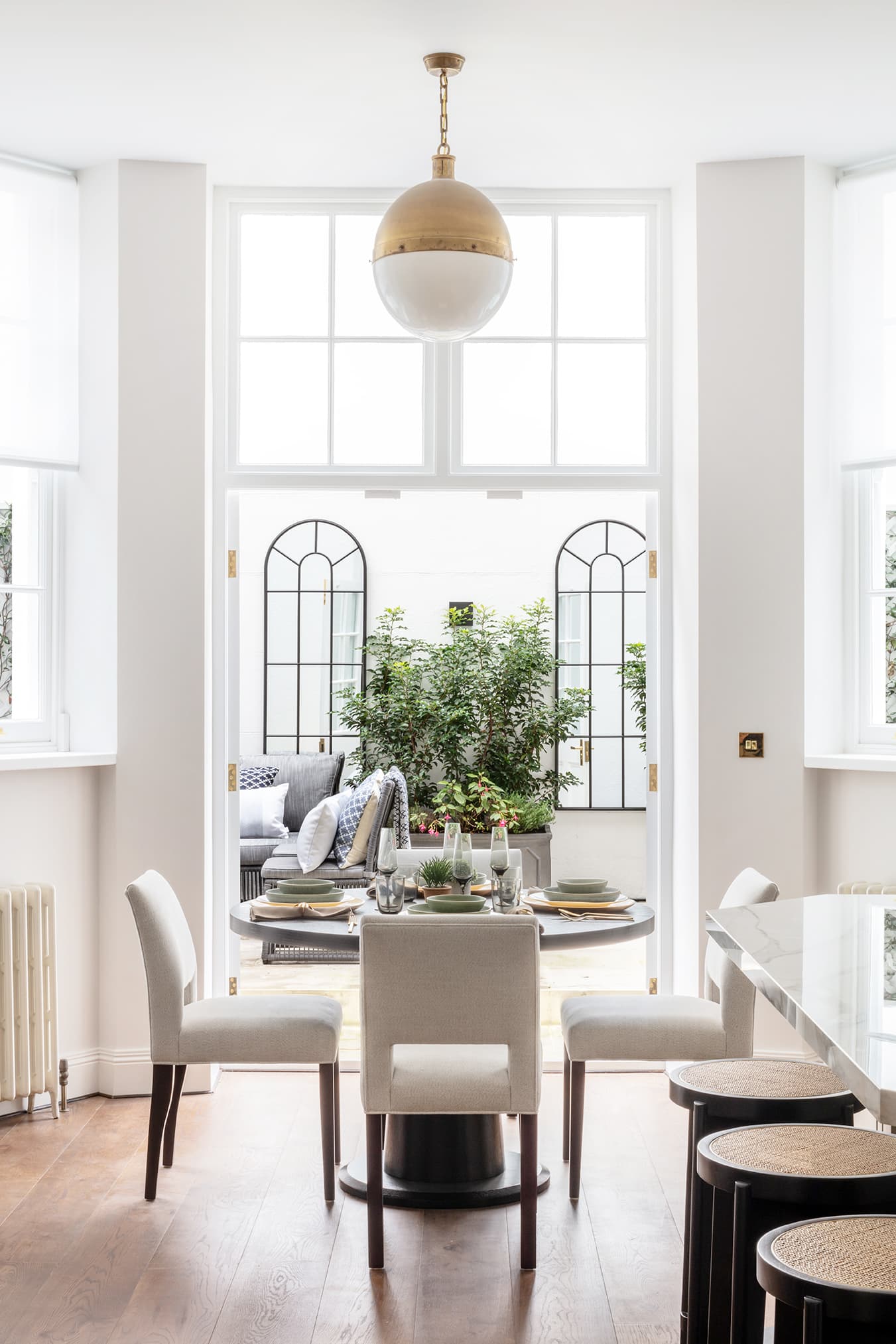
There is a room in your home that knows more about you than any other. It knows what time you wake up. It knows whether you sing while you cook. It knows the exact mug you reach for first, and the drawer you open without looking, and the spot where the evening light turns everything the colour of honey.
It is your kitchen. And if it is the right kitchen — a kitchen that was made for you rather than merely sold to you — it is the room you will never quite want to leave.
This is not a design guide. We have plenty of those, and they are useful in their own right. This is something different. This is about what a kitchen means. What it does to a home when it's right. And what it quietly takes from a home when it isn't.
The Room That Holds Everything
Every house has a front door. But the kitchen is the real entrance.
Think about it. When friends arrive for supper, they don't linger in the hallway. They drift towards the warmth, the noise, the smell of something good. Children do their homework at the kitchen table not because there isn't a desk upstairs but because the kitchen is where life is. The dog sleeps under the island. The post piles up next to the toaster. The most important conversations of your week — the ones about school, about work, about nothing in particular, about everything — happen while someone is chopping onions or pouring a glass of wine.
The kitchen is the emotional centre of a home. Not the sitting room, which waits politely for guests. Not the bedroom, which is private. The kitchen is the room that holds everything: the ordinary and the celebratory, the rushed and the lingering, the first coffee of the morning and the last conversation of the night.
And yet, remarkably often, it is designed as an afterthought. A collection of units arranged around plumbing points. A set of finishes chosen from a brochure. A room that functions well enough but doesn't feel like much of anything at all.
We think that's a waste. Not of money — though kitchens are not inexpensive — but of possibility.
The Difference Between Using and Loving
You can use a kitchen without loving it. Millions of people do, every day. They cook perfectly good meals in rooms that give them no particular pleasure. The layout is adequate. The storage is sufficient. The surfaces wipe clean. It works.
But there is a different experience altogether — and once you've had it, you can't unknow it. It is the experience of a kitchen that you love. A kitchen where you find yourself lingering after the washing up is done, not because you're avoiding something but because the room itself feels good. The light is right. The surfaces feel beautiful under your hands. The proportions are generous without being extravagant. Everything has a place, and every place makes sense, and you didn't have to think about any of it because someone thought about it for you.
This is what luxury kitchen inspiration actually looks like in practice. Not a photograph in a magazine — though photographs are lovely — but a lived experience. The sound of a heavy drawer closing with that particular soft thud. The feel of a hand-finished oak shelf, slightly warm to the touch. The sight of your favourite cookbooks ranged along a shelf that was built to hold them, at exactly the height where you can read the spines without bending.
These things seem small. They are not small. They are the difference between a room you pass through and a room you inhabit.
What Makes a Space Feel Like Yours
There is a moment in every project we undertake at Albury House when the conversation shifts. The client stops talking about what they've seen in other kitchens and starts talking about their own life. They mention that they always make sourdough on Saturday mornings. That their children sit at the island to draw. That they host Christmas for fourteen people and need somewhere to rest six serving dishes simultaneously. That they like Radio 4 while they cook but their partner prefers silence.
This is where design begins. Not with dimensions and elevations — those come later — but with an honest, unhurried understanding of how a particular family actually lives.
A kitchen designed around your real life is a fundamentally different thing from a kitchen designed around a showroom fantasy. Showroom kitchens are beautiful, of course. They are also empty. There are no cereal boxes on the worktop, no school permission slips magnetised to the fridge, no evidence that anyone has ever cooked a Tuesday evening supper in mild desperation with a child hanging off one leg. Showroom kitchens exist in a world without Tuesdays.
Your kitchen needs to handle Tuesdays beautifully.
It needs to handle the morning scramble when three people need the kettle and the toaster at the same time. It needs to handle the Sunday lunch that expands from six to ten because your sister rang that morning. It needs to handle the quiet Wednesday evening when it's just you, a bowl of pasta, and the crossword. And it needs to make all of these moments feel easy, natural, and — this is the part that matters — pleasurable.
This is what we mean when we say a kitchen should work as hard as you do and look considerably better.
The Details You Feel But Don't See
The best kitchens share a quality that is difficult to photograph and impossible to fake. Everything feels right. Not showy, not conspicuous, just quietly, completely right.
This quality lives in the details. The way a door closes — not with a bang or a rattle but with a firm, satisfying click that tells you something about the quality of the hinge, the weight of the timber, and the precision with which one was fitted to the other. The way a worktop edge has been eased to a profile that feels comfortable under your forearms when you lean on it — because you will lean on it, probably more than you think.
It lives in the materials. A kitchen made from honest materials ages in a way that synthetic surfaces cannot. Timber develops a patina. Natural stone acquires character. Hand-painted finishes deepen and soften over the years until the kitchen looks not older but more settled, more itself. This is the difference between materials that endure and materials that merely last.
And it lives in the light. Good kitchen design is, at its heart, a negotiation with light. Where does the morning sun enter? Where does it fall at four o'clock on a winter afternoon? Where do you need task lighting that illuminates without casting shadows, and where do you need the warmer, softer glow that turns supper into an occasion? These questions don't appear on a standard kitchen specification. But they determine whether a room feels alive.
At Albury House, the craftsmanship behind these details is the invisible backbone of everything we make. We don't talk about dovetail joints and hand-sprayed lacquer because we think you should have to care about joinery. We care about joinery so that you don't have to. What you notice is simply that everything works, everything feels solid, everything looks beautiful — and it still does ten years later.
Morning Rituals and Evening Light
Let us be specific, because kitchens are specific.
The first cup of coffee in the morning. You make it half-asleep, by touch as much as by sight. The machine is where your hand expects it to be. The cup is in the cupboard closest to the machine, not across the room. The surface you set it down on while you wait for the milk to heat is the surface directly in front of you, at exactly the right height, and it doesn't stain, and it doesn't scratch, and it has a warmth to it that cold composite never quite achieves.
This takes about ninety seconds. But a kitchen designer has thought about every one of them.
Or consider Sunday lunch. The oven is on, the potatoes are in, the kitchen smells extraordinary. People are milling about — someone is laying the table, someone is stealing a roast potato, someone is telling a story that requires both hands. The kitchen accommodates all of this without anyone bumping into anyone else, because the island is the right width, the traffic flow doesn't cross the cooking zone, and there is a stretch of worktop — every good kitchen has one — that exists purely for people to lean against with a glass in their hand and nowhere in particular to be.
Or a Tuesday. A nothing-special Tuesday in November. It's dark by five. You come home, put the radio on, and start cooking something simple because simple is what you need. The under-cabinet lighting comes on and the room transforms: warm, enclosed, entirely yours. The knife is sharp because the drawer it lives in was designed to hold it properly. The chopping board slides out from its purpose-built slot. The bin opens at a touch. None of this is dramatic. All of it is a pleasure.
These are the moments that a bespoke kitchen is really designed for. Not the photographs, not the grand reveal, but the ten thousand ordinary evenings that follow.
Beyond the Showroom Fantasy
We are sometimes asked what separates our kitchens from the very good fitted kitchens available from well-known brands. It is a fair question, and the honest answer is this: from a photograph, sometimes very little. The difference is in the living.
A fitted kitchen, however beautifully finished, is assembled from a library of standard components. The carcass depths are fixed. The drawer widths follow a grid. The design works within these constraints, and a skilled designer can make it work very well indeed. But there are always small compromises — a gap filled with a panel, a cupboard slightly too deep for the wall it sits against, a layout that almost flows but doesn't quite.
A bespoke kitchen has no grid. Every element is drawn for your room, manufactured for your room, and fitted to your room. The difference is felt rather than seen. It is the absence of those small compromises — the sense that nothing has been forced, nothing has been patched, nothing is nearly right. Everything is just right.
This matters more than you might expect. A kitchen is not a piece of furniture you can replace when you tire of it. It is an architectural intervention — a room within a room — and it will shape how you live for a decade or more. Getting it right is not extravagance. It is, in the most practical sense, an act of care.
A Kitchen That Grows With You
The best kitchens — the ones their owners never tire of — share one final quality. They are not designed for a moment. They are designed for a life.
The family that commissions a kitchen when the children are small is not the same family five years later, when the children are doing GCSEs and eating everything in the house. The couple who cook together every evening may, at some point, become the couple who entertain every weekend. Life changes shape. A good kitchen accommodates this without needing to change itself.
This is why we resist fashion and pursue proportion. Fashionable kitchens date. Well-proportioned kitchens endure. A beautifully made Shaker kitchen looks as right today as it did in 1820, not because Shaker design is trendy but because its proportions are honest. The same principle applies to contemporary schemes: clean lines and restrained detailing will always look considered, long after the TikTok trend of the moment has been forgotten.
When we talk about luxury kitchen inspiration, what we really mean is this: the inspiration to invest not in a kitchen that impresses visitors but in a kitchen that makes you happy. Every morning, every evening, every unremarkable Tuesday for the next twenty years.
An Invitation
If you have read this far, you are probably someone who understands that a kitchen is more than a room where food is prepared. You understand that it is the room where your family gathers, where your friendships deepen over slow meals, where the rhythm of your daily life finds its tempo.
We would love to talk to you about yours.
Not a sales conversation — just a conversation. About your home, your family, the way you cook and eat and live. About what you love about your current kitchen and what you'd change if you could change anything. About materials and light and the particular quality of a room that feels completely, unmistakably yours.
That conversation is where every Albury House kitchen begins. And it costs nothing but a little of your time and, if we're visiting, a cup of tea.
Frequently Asked Questions
Thinking about a new kitchen?
Book Your Free ConsultationYou might also enjoy
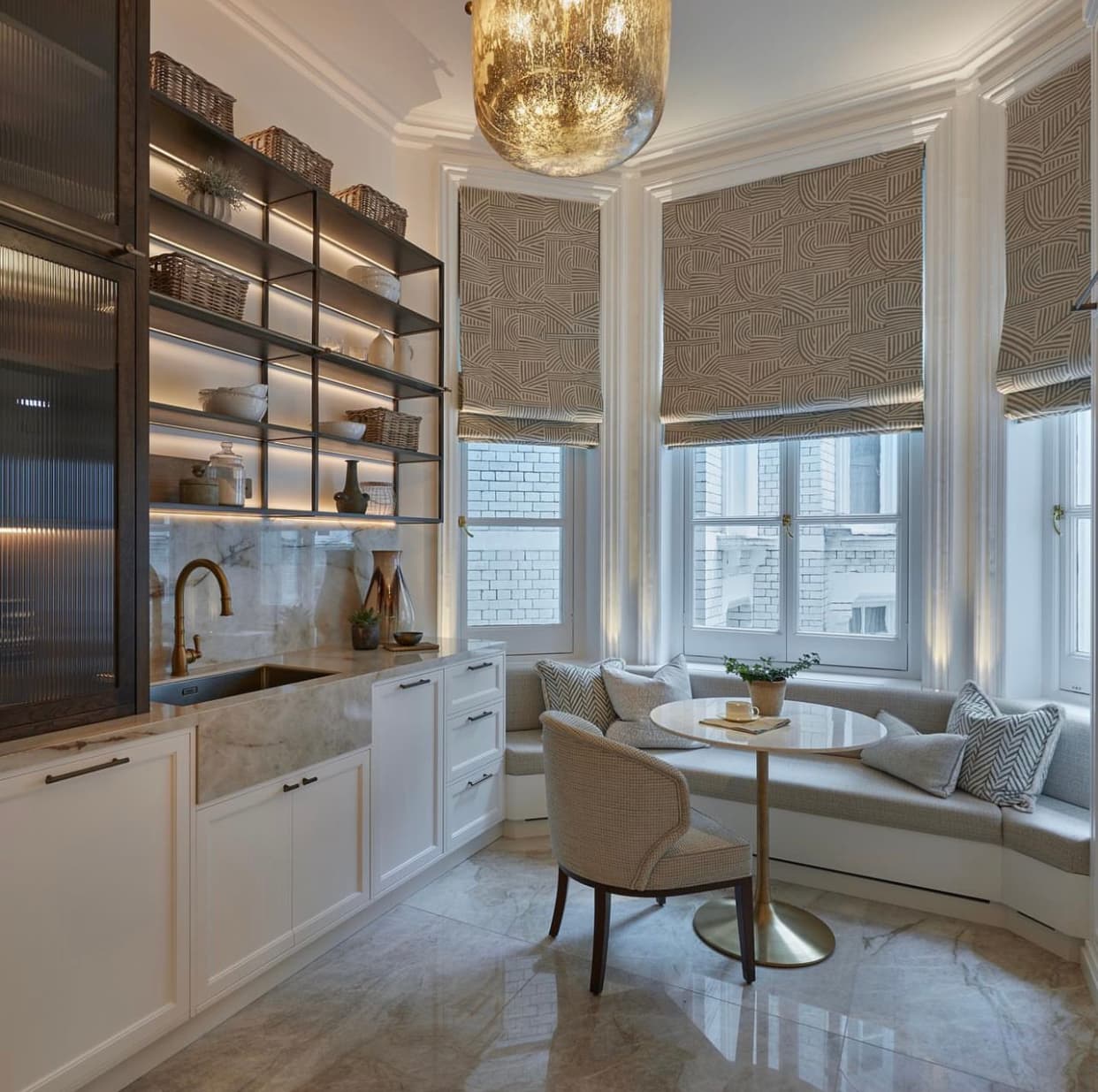
Banquette Seating Kitchen: The Art of Built-In Dining Done Properly
Explore how banquette seating transforms kitchen dining — from L-shaped corners and curved booths to storage-smart benches, upholstery choices, and dimensions that actually work. Inspiration for bespoke kitchens that invite you to sit down and stay.
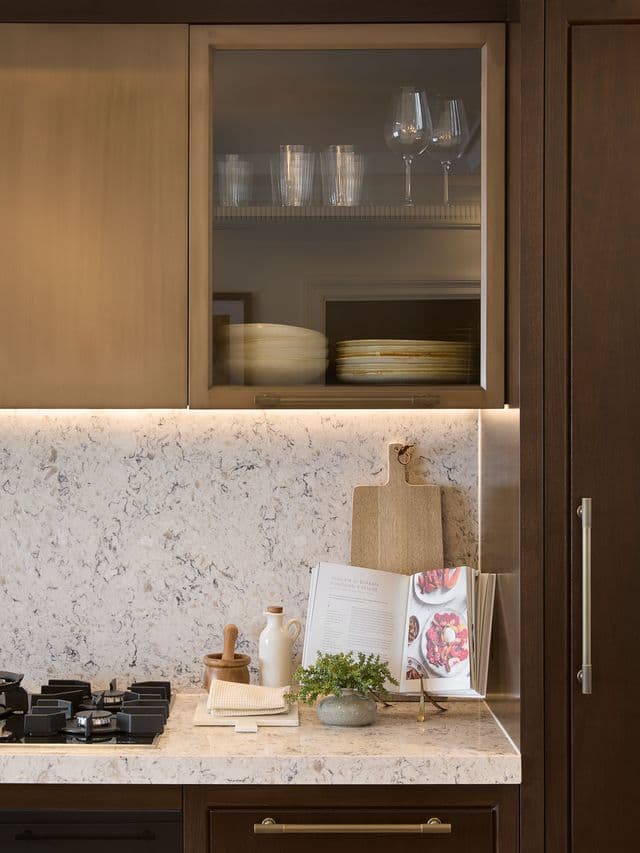
Arts and Crafts Kitchen Design: Where Handcraft Meets the Heart of the Home
Explore how the Arts and Crafts movement inspires truly bespoke kitchen design — from hand-forged ironmongery and English oak to William Morris colour palettes. A guide to creating kitchens that honour the handmade.
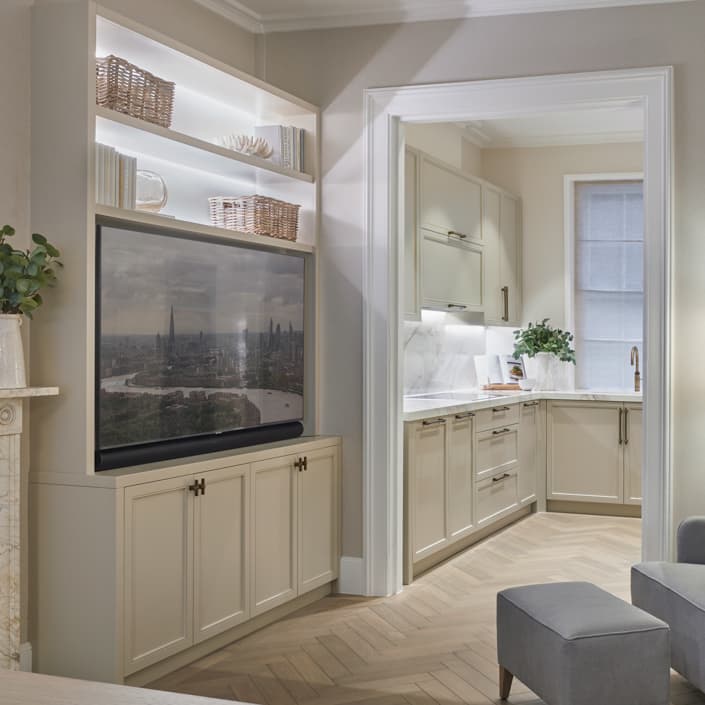
Barn Conversion Kitchen Design: Bespoke Kitchens for Extraordinary Spaces
Designing a kitchen for a barn conversion demands a bespoke approach. From double-height ceilings and exposed trusses to acoustic management and island design, discover how Albury House Kitchens creates luxury kitchens that honour agricultural architecture whilst delivering modern performance.